

You've probably felt this kind of pain before. A deep ache in the hip turns into a stiff walk, then starts creeping into the thigh or knee, and suddenly it's not obvious whether the problem is the joint, the back, or both. That uncertainty matters, because the right treatment depends on determining the underlying cause of the pain.
Hip Artery Embolization, often shortened to HAE, is one of the newer minimally invasive options for chronic hip pain. It grew out of established hip-region embolization techniques that were first used to control bleeding and vascular complications after hip or pelvic surgery, then later adapted for pain care in selected patients pubmed.ncbi.nlm.nih.gov/24190636. For people who've already tried conservative care and still can't move comfortably, it offers a different idea than medication alone or immediate surgery.
Table of Contents
- Is It Your Hip or Your Back
- The Diagnostic Journey to Find the Source
- Mapping Your Treatment Options for Hip Pain
- A Closer Look at Hip Artery Embolization
- HAE Candidates Recovery and Outlook
- Taking the Next Step to Control Your Hip Pain
Is It Your Hip or Your Back
A lot of people assume that pain in the thigh or knee must be coming from the spine. That's understandable, because the body can send pain signals in ways that feel misleading. A hip problem can act like crossed wires in a house, where the damaged switch is in one room but the flickering light shows up somewhere else.
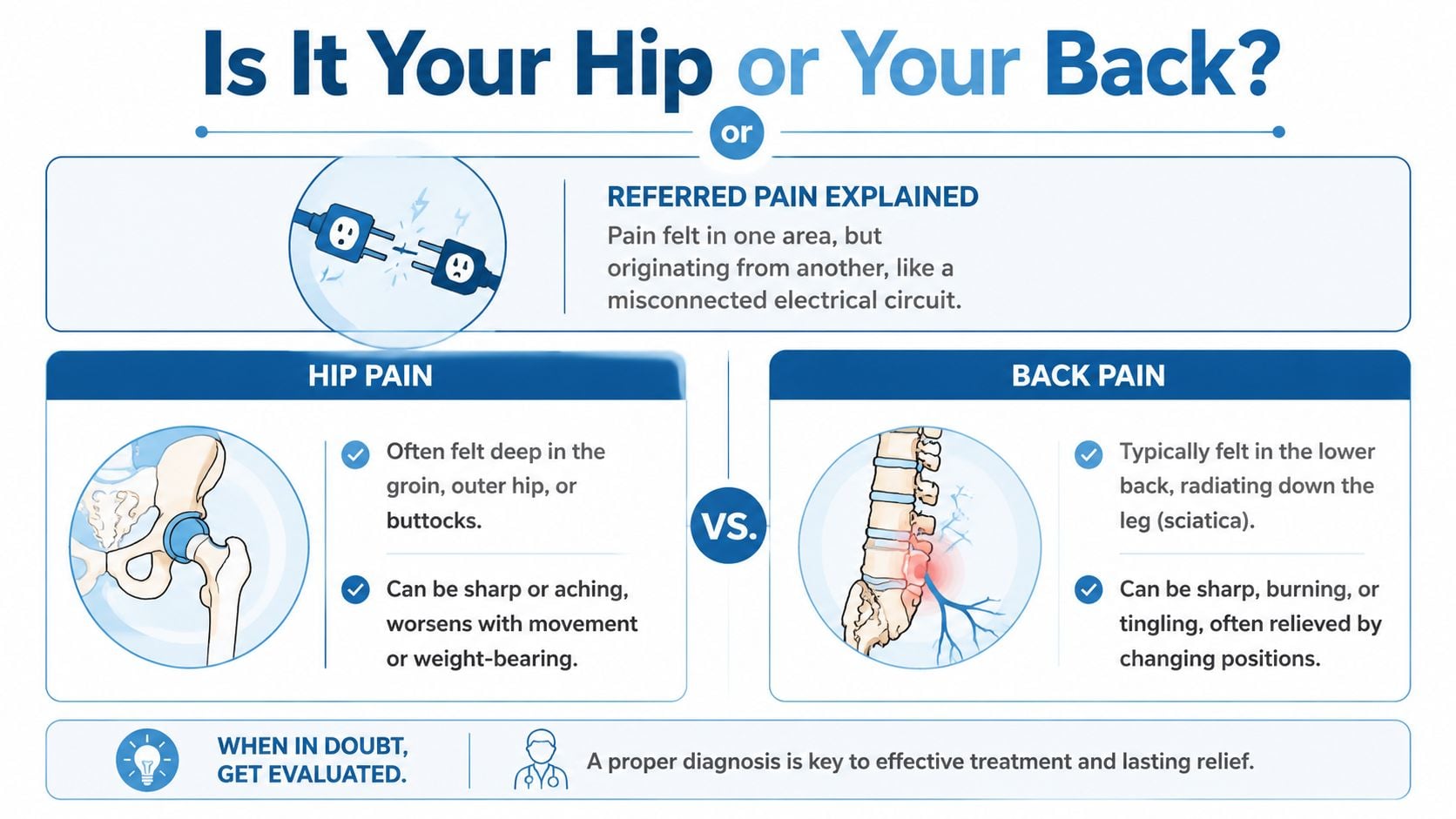
Referred pain feels confusing, but it follows patterns
Hip-driven pain often shows up deep in the groin, in the outer hip, or across the front of the thigh. People also describe stiffness after sitting, trouble getting out of a car, or pain that worsens with weight-bearing. That pattern matters because the hip joint is built to carry load, so irritated joint surfaces often complain when pressure increases.
Back-related pain more often starts in the low back or buttock and travels down the back of the leg, sometimes with numbness or tingling. That pattern is the one many people associate with sciatica, and it's discussed in more detail in this overview of sciatica and pinched nerve symptoms. A spinal problem can still coexist with hip disease, which is why symptom location alone doesn't tell the whole story.
Practical rule: pain that gets worse with walking, standing from a chair, or putting weight on the leg deserves a careful hip exam, even if it seems to travel downward.
A few clues usually help separate the two
Hip pain often feels mechanical. It tends to be worse when the joint moves through a limited arc, especially with rotation, bending, or rising from a low seat.
Back pain more often changes with posture in a broader way, especially if bending, twisting, or sitting triggers symptoms that run down the leg. Numbness, tingling, or a burning quality pushes the clinician to look more closely at the spine.
The key is not to self-diagnose based on one symptom. The safest path is to describe where the pain starts, where it travels, and what actions aggravate it. That story gives the doctor the first strong clue about whether the hip, the spine, or both need attention.
The Diagnostic Journey to Find the Source
A good diagnosis starts with the patient's story, because pain behaves differently depending on what's damaged. One person may describe a sharp catch when getting into a car, while another notices a slow ache after long walks. Those details often point in different directions before a scan ever comes into play.

History, exam, and imaging each answer a different question
The medical history tells the clinician what kind of pain pattern is developing. Questions about stiffness after rest, groin pain, walking tolerance, sleep disruption, and prior injuries all help separate joint pain from nerve pain.
The physical exam adds more precision. Doctors may check range of motion, rotate the leg inward and outward, and look for pain provoked by specific movements. If the hip itself is the pain generator, certain maneuvers tend to reproduce the complaint more reliably than general back motion.
Imaging then shows the structure behind the symptoms. X-rays can reveal joint wear or alignment issues, while MRI can help evaluate cartilage, soft tissue, and other non-bony problems. A patient with mechanical symptoms and a suspicious scan may also need evaluation for conditions like labral tears, because more than one hip problem can be present at the same time.
Bringing old reports, prior images, and procedure notes to the visit can save time and help avoid duplicate testing.
A careful record makes the visit more useful
That's why organized records matter. A well-kept file with prior imaging, medication lists, therapy notes, and procedure summaries gives the physician a cleaner picture of what has already been tried. A practical guide on medical record organization tips can help families keep that information in one place.
A thorough workup isn't about ordering everything available. It's about matching the right test to the right question so the next treatment choice is based on evidence, not guesswork. For hip pain, that step is essential because the wrong target leads to the wrong procedure.
Mapping Your Treatment Options for Hip Pain
A painful hip can feel confusing because the right next step is not always the most aggressive one. Treatment usually works best as a ladder, with care starting at the least invasive level and moving upward only if pain keeps interfering with daily life. That approach helps because some hips improve with simple measures, while others need a procedure to get meaningful relief.
Conservative treatment often begins with physical therapy, activity changes, and medication strategies aimed at lowering irritation while preserving motion. Some patients also benefit from weight management, targeted strengthening, and small changes in daily mechanics, like how they sit, stand, or climb stairs. If the joint is overloaded every day, it will usually stay irritated until those movement patterns change.
A side-by-side view helps narrow the choice
| Treatment Type | Goal | Method | Best For |
|---|---|---|---|
| Conservative care | Reduce irritation and protect joint function | Physical therapy, activity changes, medication strategies | People with early or moderate symptoms who can still improve without a procedure |
| Image-guided injections | Calm inflammation or clarify the pain source | Corticosteroid injections or similar targeted treatments | Patients who need short-term relief or diagnostic clarification |
| Other interventional options | Address specific pain pathways | Nerve-focused procedures or joint-adjacent interventions | People with persistent pain who haven't done well with simpler care |
| Hip Artery Embolization (HAE) | Reduce abnormal blood flow linked to pain | Image-guided catheter treatment that blocks abnormal vessels | Selected patients with chronic hip pain who want a minimally invasive option |
| Surgery | Replace or reconstruct the damaged joint | Orthopedic surgery, including replacement when appropriate | People with advanced joint damage or structural disease that responds poorly to nonsurgical care |
For some patients, a hyaluronic acid injection overview helps frame where injections fit in the broader picture, especially when the goal is to delay escalation rather than move straight to surgery. It can be easier to understand treatment choices when you compare them to a toolkit, where each tool has a specific job and is not meant for every problem.
Clinical logic: the best treatment is usually the one that matches the level of joint damage, the pain pattern, and the person's goals, not the loudest symptom.
The older history of hip-region embolization also helps explain why specialists view the technique as plausible. A single-center study of postoperative hip and pelvic bleeding complications reported successful catheter-based embolization in that setting pubmed.ncbi.nlm.nih.gov/24190636. That earlier work showed that accessing hip-area vessels through a catheter can be precise and dependable before the approach was adapted for pain treatment.
This full treatment map matters because HAE is not meant to replace every other option. It sits in the middle of the spectrum, between conservative care and major surgery, for patients who need more than exercise and pills but are not necessarily ready for an implant.
A Closer Look at Hip Artery Embolization
Hip Artery Embolization works on a simple idea. Some painful hips develop abnormal tiny blood vessels around inflamed tissue, and those vessels help keep the pain cycle going. The procedure aims to reduce that abnormal blood flow, much like pruning overgrown branches so a fire loses fuel.
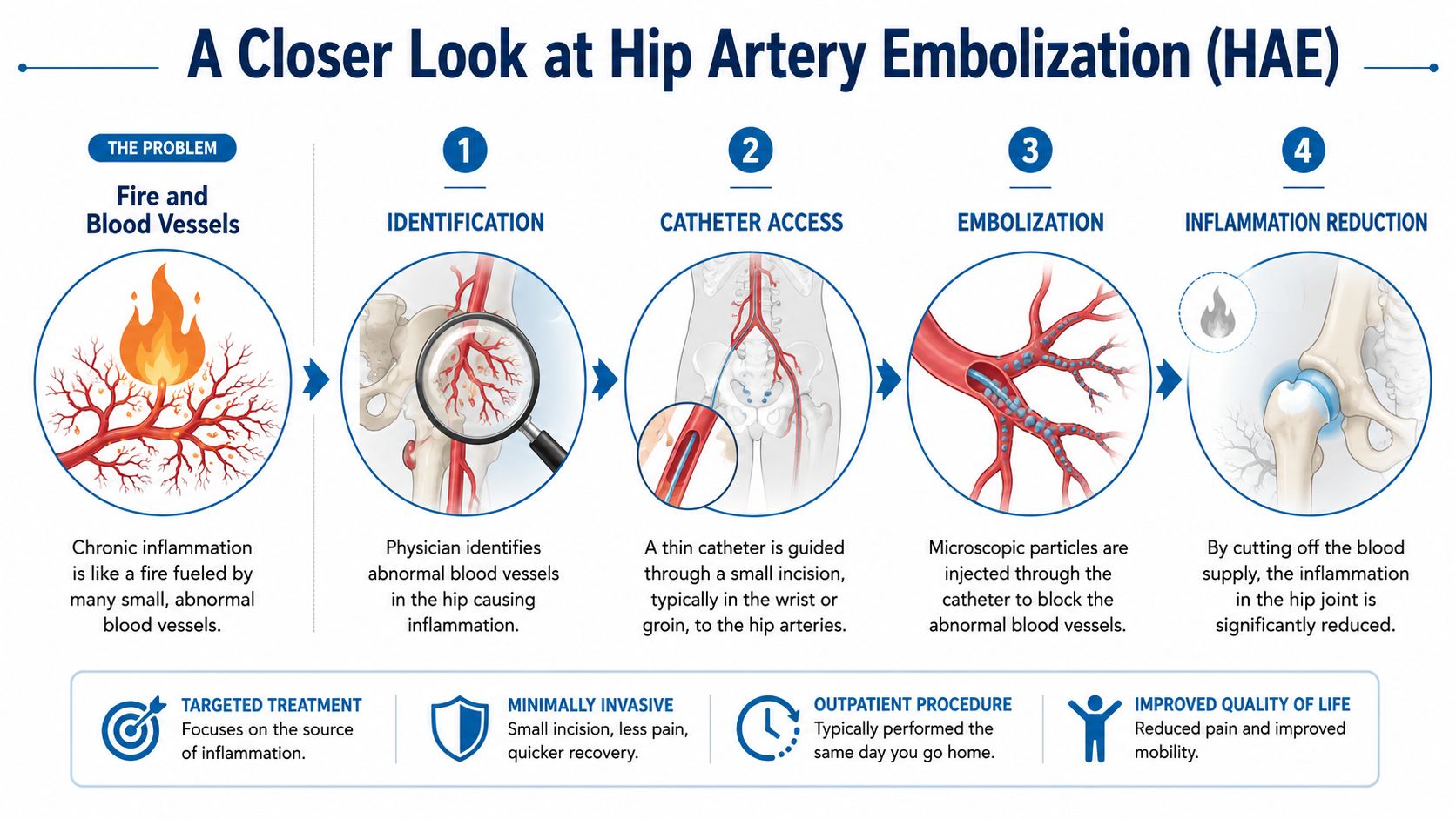
What happens during the procedure
The specialist uses live imaging to guide a tiny catheter through an artery and toward the vessels feeding the painful hip region. The procedure is usually done as an outpatient treatment under local anesthesia, rather than open surgery, so the body is not exposed to the same level of tissue disruption that comes with an operation.
Once the catheter reaches the target area, microscopic embolic particles are used to block the abnormal vessels. The goal is not to shut off the entire hip's circulation. It is to selectively reduce the hyperemic vessels thought to feed inflammation while preserving the main arterial supply.
What the patient experience usually feels like
Patients typically remain awake but comfortable, as the procedure relies on local anesthesia and careful monitoring. The workflow is designed to minimize trauma, which is one reason it appeals to patients looking for a less invasive alternative.
A pilot study reported that the largest improvement often appeared within the first week and then persisted through 12 weeks. That timing fits the experience many patients hope for, a noticeable change without a long hospital stay or a major surgical recovery.
The evidence also supports the biologic logic. In a 2025 study of symptomatic hip osteoarthritis, the median pain score fell from 7 to 4 at 12 months, and no major adverse events were reported pubmed.ncbi.nlm.nih.gov/42026166. The same study linked reduced pathologic blood flow with meaningful pain relief and functional improvement, which strengthens the case that HAE is not just a mechanical trick, it targets part of the pain process itself.
HAE narrows the supply lines that keep irritated tissue active, not the joint itself.
That distinction matters. HAE can reduce pain signals and improve function, but it does not rebuild cartilage or undo every structural change in an arthritic hip.
The procedure has also been described in earlier catheter-based embolization work for postoperative hip and pelvic bleeding complications, which helps show why specialists see the approach as technically plausible pdfs.semanticscholar.org/4716/d775ccc5a29d49e5ecbf73eeb8cfac18c17e.pdf.
HAE Candidates Recovery and Outlook
A patient who has tried medication, physical therapy, or activity changes and still has deep hip pain may start asking whether there is a middle path between living with it and having major surgery. That is where Hip Artery Embolization can enter the conversation. It is most often considered for people with osteoarthritis who want a less invasive option, especially when surgery is not a good fit or does not feel like the right next step.

What the evidence suggests, and what it still doesn't prove
The HipE Study reported 12-month clinical success in 73% of patients pmc.ncbi.nlm.nih.gov/articles/PMC9401195. That is encouraging because it suggests the procedure can provide meaningful benefit beyond the earliest phase of treatment, and it helps explain why some specialists now view HAE as more than an experimental idea.
The evidence is still developing, though. A recent prospective pilot in elderly patients who were not surgical candidates showed fast pain relief and better function through 12 weeks pmc.ncbi.nlm.nih.gov/articles/PMC12676639. The study was small, so it does not fully answer who is most likely to benefit, how long the relief lasts once the first few months pass, or how often a repeat procedure might be needed. For that reason, HAE is best viewed as a selected-patient option, a treatment that may fit some people well and be the wrong tool for others.
Recovery is usually lighter than surgery
HAE is performed through a small catheter entry point, so recovery is usually easier than after open joint surgery. The short-term problems described in the literature have generally been minor. In the HipE Study, only 2 grade 1a adverse events were reported, and both were groin hematomas pmc.ncbi.nlm.nih.gov/articles/PMC9401195. That kind of access-site bruise is more like a sore spot after a blood draw or catheter procedure than the prolonged recovery many patients associate with surgery.
For patients trying to decide whether HAE fits their plan, that lighter recovery matters. The procedure may help someone move with less pain and avoid the burden of an implant or open operation, but it is still aimed at a specific pain pattern and a specific type of candidate. It does not rebuild cartilage, and it does not correct every structural change in an arthritic hip.
The right decision depends on the anatomy, the intensity and pattern of the symptoms, and the patient's goals. In practice, that means HAE may belong near the top of the treatment plan for one person, while another person may be better served by a different conservative, interventional, or surgical option first.
Taking the Next Step to Control Your Hip Pain
Chronic hip pain doesn't need to stay vague or untreated. A good plan starts with a clear diagnosis, then moves through the full range of options, from home-based care and therapy to injections, embolization, or surgery when needed. The most useful decision is the one made after the hip has been properly identified, not after months of guessing.
A few red flags deserve prompt attention. Sudden inability to bear weight, fever with a hot swollen joint, new numbness or weakness in the leg, or pain that's escalating quickly should be reviewed right away. Those signs can point to something more urgent than routine arthritis.
Simple steps can still help while waiting for evaluation. Activity pacing, short walking breaks, and avoiding movements that reliably trigger pain can reduce flare-ups. Keeping a symptom diary, including where the pain starts and which positions make it worse, can also make the specialist visit more productive.
The smartest next move is a thorough consultation with a team that can sort out hip, spine, and joint causes together. That kind of evaluation gives the best chance of matching the right treatment to the right pain source.
A CTA for Interventional Pain Management.