
Knee osteoarthritis can wear a person down in quiet ways. First it's the stairs. Then it's the morning stiffness, the hesitation before standing up, and the familiar question of whether another injection will help for long enough to matter. For people who are stuck between temporary relief and the prospect of joint replacement, Genicular Artery Embolization (GAE) offers a different path, one that aims at the inflamed blood supply inside the knee rather than at the joint surface itself.
For referring physicians, the appeal is just as practical. GAE has become part of the conversation because it fills a real gap in care, especially for patients who still have meaningful symptoms despite conservative treatment and who aren't ready for arthroplasty, or aren't ideal surgical candidates. It's also important that this procedure didn't appear out of nowhere as a pain trend, it evolved from an established interventional method that was first used for recurrent hemarthrosis after total knee arthroplasty and later adapted for refractory osteoarthritis pain, which helps explain its place in modern musculoskeletal care. The broader surgical decision still matters, and the patient-facing context around joint replacement surgery remains part of the discussion.
Table of Contents
- Beyond Injections and Knee Replacement
- Understanding Genicular Artery Embolization
- Is GAE the Right Choice for Your Knee Pain
- The GAE Procedure A Step by Step Patient Guide
- Benefits Risks and Realistic Outcomes
- Comparing GAE to Other Knee Pain Treatments
- Your GAE Journey in New Jersey and Staten Island
Beyond Injections and Knee Replacement
A common story starts the same way. A person with knee osteoarthritis tries physical therapy, anti-inflammatory medicine, and injections, but the relief fades before the next appointment, and the day-to-day limits keep coming back. Walking the dog becomes a negotiation, getting out of a car takes planning, and sleep gets interrupted by an aching knee that never fully settles down.
That's where GAE gets attention. It's not a cure-all, and it doesn't rebuild cartilage, but it does offer a minimally invasive option for pain that keeps showing up after conservative care has already done as much as it can. In plain terms, the procedure targets the abnormal blood vessels that help sustain inflammation inside the arthritic knee, so the pain source is addressed closer to the problem itself. For readers trying to understand where this fits in the care pathway, the clinical framing around osteoarthritis care is useful because GAE sits between routine symptom management and major surgery.
Practical rule: if a knee still hurts after standard non-surgical treatment, the next step isn't always “keep waiting” or “go straight to replacement.”
For patients, that middle ground matters because it creates breathing room. For clinicians, it matters because symptom burden, imaging findings, functional goals, and surgical timing don't always line up neatly. Some patients want to delay arthroplasty. Others need time because of medical issues, work demands, caregiving responsibilities, or fear of a long recovery.
The value of GAE is that it can be discussed as a staged option, not as a commitment to surgery and not as a promise that surgery will never be needed. That makes the conversation more honest, and for many patients, more helpful.
Understanding Genicular Artery Embolization
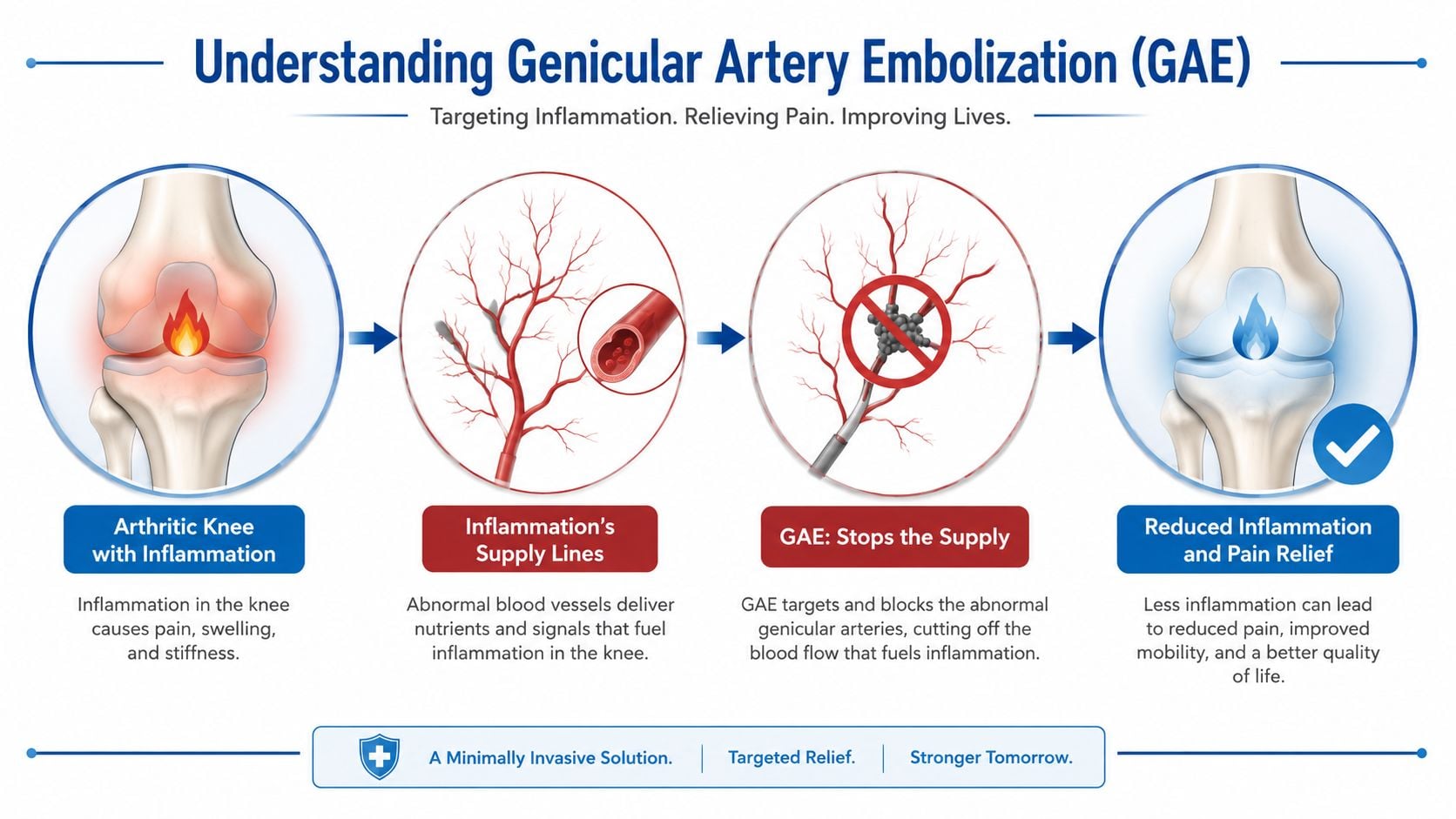
Think of an inflamed arthritic knee like a small fire that keeps getting fed. In that picture, the extra tiny blood vessels around the joint are the supply lines. GAE works by selectively blocking those supply lines so the inflammatory process cools down.
What the procedure is actually targeting
The medical term for those extra vessels is synovial neovascularity, which just means new blood vessels forming in the lining of the joint. Those vessels can keep feeding swelling, irritation, and pain signals. The point of embolization is not to shut down the whole knee's blood supply, it's to stop the abnormal blush of hypervascularity while preserving the main arteries that keep the leg perfused.
That precision matters. Technical reviews describe GAE as a superselective endovascular procedure, where a microcatheter is guided into the genicular branches and tiny embolic particles are delivered until the unwanted vascular blush disappears. The same review explains that operators use careful contrast runs and small embolic aliquots to reduce reflux and non-target embolization risk, which is part of why the procedure belongs in experienced hands. Technical description of superselective genicular embolization
Why its history matters
GAE didn't start as a knee osteoarthritis treatment. It was originally developed for recurrent hemarthrosis after total knee arthroplasty and later expanded into treatment for refractory osteoarthritis pain. That history helps explain why the procedure is discussed so often in interventional radiology and musculoskeletal pain care, because the approach grew out of an established vascular technique rather than a purely experimental concept. A 2025 practical guide reported 99.7% technical success, with minor, transient complications and only 2.0% of patients needing medication for adverse events, which supports its profile as a highly feasible minimally invasive option. Practical guide on genicular artery embolization
The goal isn't to freeze the joint. It's to quiet the inflammatory blood flow that keeps the pain cycle active.
For patients, that explanation often makes the procedure easier to understand. For referring physicians, it clarifies why GAE is best seen as an image-guided intervention with a defined vascular target, not as a broad pain procedure without an anatomical rationale.
Is GAE the Right Choice for Your Knee Pain

The best candidates usually look similar on paper, even if their daily lives look different. They have mild-to-moderate knee osteoarthritis, persistent symptoms despite conservative care, and a reason to want something less invasive than arthroplasty. A review of the field describes this group as the strongest evidence base for GAE, and it also notes that the outpatient procedure typically takes 45 to 90 minutes and can produce sustained 6-month improvement in pain scores in about 80% to 85% of patients. Review of GAE in knee osteoarthritis
The questions that point toward candidacy
A useful way to think about candidacy is to ask a few direct questions.
- Has conservative care already been tried? If physical therapy, medications, and injections have not provided lasting relief, GAE becomes more relevant.
- Is the arthritis still in the mild-to-moderate range? The evidence is strongest there, because the procedure is aimed at inflammatory pain rather than complete joint destruction.
- Is surgery being delayed or avoided for a reason? That may be personal preference, medical risk, work demands, or not being ready for a major operation.
- Is the main problem pain and function, not a need for structural repair? GAE is designed to reduce symptoms, not replace cartilage.
A patient with severe bone-on-bone degeneration may still ask about the procedure, but that conversation needs to be honest about likely limits. If the joint is mechanically failing, embolizing small vessels won't reverse that structural damage. In those cases, the question becomes whether symptom relief now is worth pursuing before a later operation, not whether GAE can substitute for every surgical need.
Clinical checkpoint: the right candidate is often someone who wants to move better now, but isn't ready to accept the recovery and tradeoffs of major surgery.
For families comparing coverage and planning options, practical questions about future procedures can overlap with insurance decisions. For example, people sorting out understanding Medigap benefits in 2026 may also be thinking about how an outpatient intervention fits into broader care costs and future treatment flexibility.
The GAE Procedure A Step by Step Patient Guide
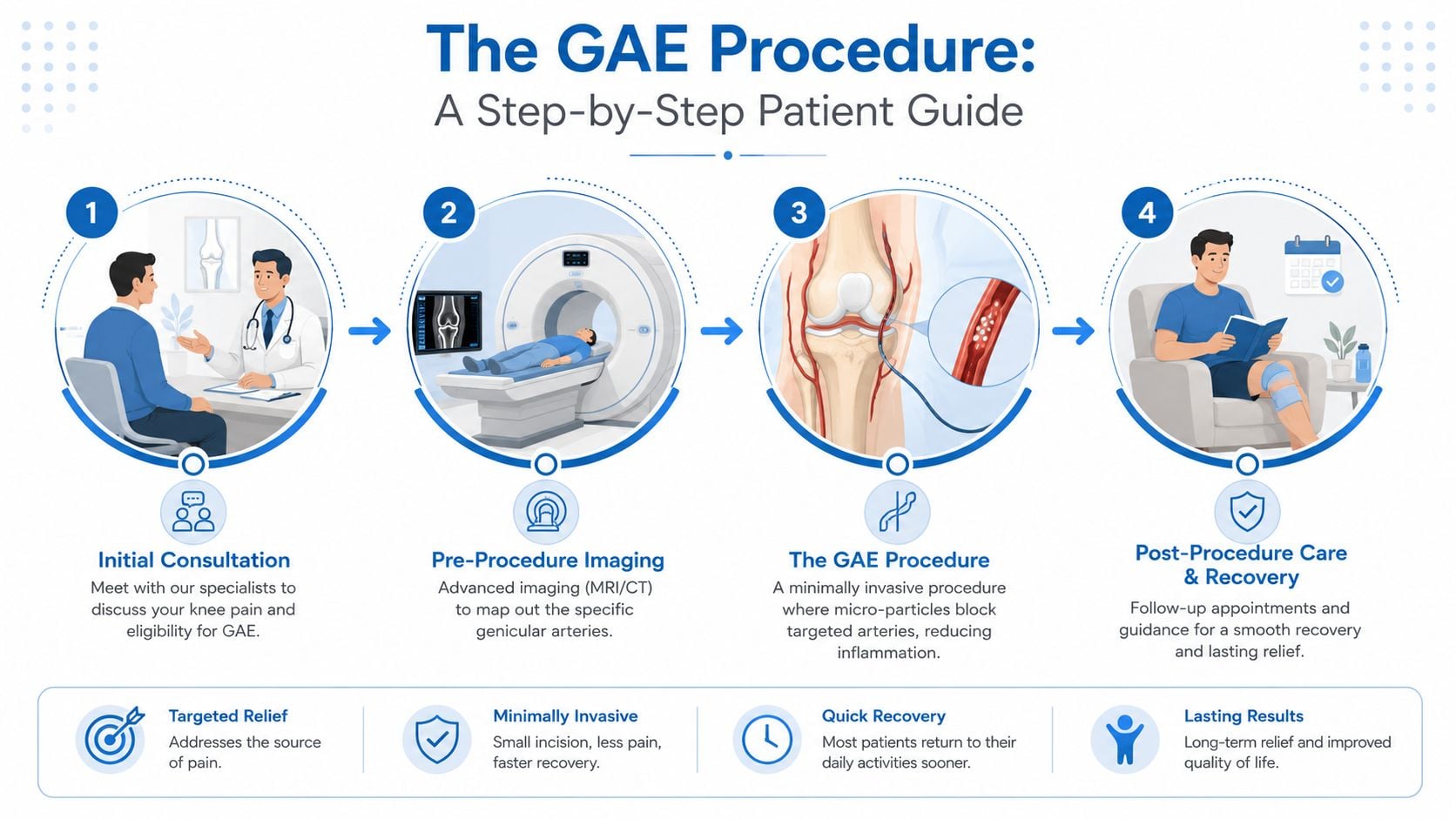
The day of treatment usually feels much less dramatic than people expect. The patient arrives, checks in, and meets the team reviewing the plan, the target anatomy, and the comfort options. Because GAE is typically done under local anesthesia or moderate sedation, the process is designed around comfort without the burden of general anesthesia.
What happens from start to finish
The procedure begins with tiny arterial access, usually through the femoral artery. From there, the physician advances a very small microcatheter into the genicular branches that feed the abnormal vascular network around the knee. The target is precise, because the embolic particles are meant to reach the hypervascular blush and stop it without closing off the main arterial supply. Technical description of GAE catheter technique
Once the target vessels are selected, the particles are delivered in careful, small amounts. The operator watches the angiographic image for the blush to fade, which signals that the abnormal blood flow has been reduced. That visual endpoint is one reason the procedure is so image-driven, and why the steps are done slowly rather than rushed.
What recovery usually looks like
After the procedure, the access site is compressed or closed, and the patient is observed briefly before going home the same day. Recovery is generally described as closer to a medical outpatient visit than to surgery. There's usually some soreness where the catheter entered, but the overall burden is much lighter than a knee operation.
For many patients, that simplicity is the point. They want relief, but they also want to get back to normal life without a long hospital stay or a heavy rehab timeline.
Benefits Risks and Realistic Outcomes
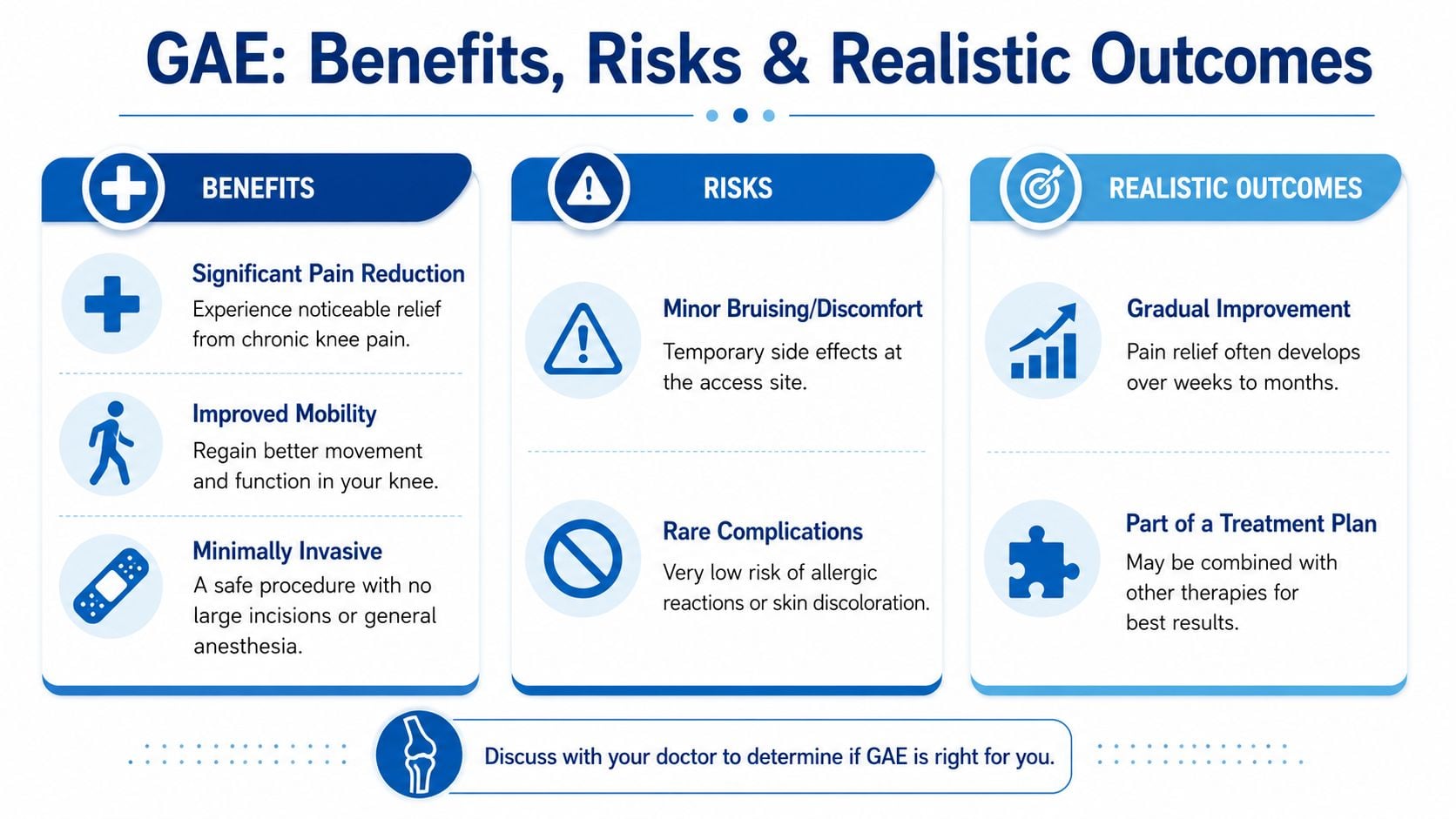
The strongest reason patients consider GAE is straightforward, pain can improve without major surgery. A review of the evidence reports sustained 6-month improvement in pain scores in about 80% to 85% of patients, and that's meaningful for someone who has been limited by walking pain, stiffness, or rest pain for months. The procedure is also outpatient, which keeps the treatment burden lighter than surgery for many people. Review of knee osteoarthritis outcomes after GAE
What the better days tend to look like
Better outcomes usually show up as easier standing, less pain with daily movement, and more tolerance for routine tasks that used to trigger symptoms. Some patients notice a gradual shift rather than a sudden change, and that's normal. The knee doesn't become new overnight, but the inflammatory drive can quiet down enough to make everyday life more manageable.
Longer-term data have started to support that durability in selected patients. In a prospective IDE trial, 40 patients were enrolled, 2 (5.0%) were lost to follow-up, and among the 38 assessed, 18 (47.4%) achieved at least a 50% reduction in WOMAC score at 24 months. Among those who had initial success at 12 months, 18 of 25 (72.0%) still had benefit at 24 months. Prospective IDE trial results
The risks need to stay visible
The good news is that the early safety profile has been favorable. The practical guide noted above reported 2.0% of patients requiring medication for adverse events and 0.3% requiring hospitalization, with complications generally minor and transient. That said, no catheter-based procedure is risk-free, and the patient should still expect discussion of access-site bruising, temporary discomfort, and the small possibility of contrast-related or vascular complications. Safety profile in practical guide
Balanced expectation: GAE is a low-burden procedure with real potential for relief, but it's still a treatment, not a guarantee.
The situation is straightforward. GAE can be a meaningful option for symptom control, especially when the patient wants to delay surgery or isn't ready for it. It may also be part of a broader pain plan that includes exercise, weight management when relevant, or other medical care, because a single procedure rarely solves every layer of knee osteoarthritis.
Comparing GAE to Other Knee Pain Treatments
For patients and clinicians making a decision, the useful question isn't just “does it work?” It's “how does it fit compared with the other options already on the table?” GAE sits in a middle space. It's more targeted than repeated injections, but far less invasive than total knee arthroplasty.
Knee Osteoarthritis Treatment Options at a Glance
| Treatment | Invasiveness | Recovery Time | Duration of Relief |
|---|---|---|---|
| Corticosteroid injections | Low | Short | Often temporary |
| Hyaluronic acid injections | Low | Short | Variable |
| Genicular Artery Embolization | Minimally invasive | Usually outpatient | Can be durable in selected patients |
| Total knee arthroplasty | Major surgery | Longer | Long-term structural solution |
That table captures the basic tradeoff. Injections may help symptoms, but they do not change the vascular inflammation pattern that GAE targets. Arthroplasty changes the joint itself, which makes it the definitive structural option when the knee is too damaged for joint-preserving care.
Bridge or alternative
The hardest strategic question is whether GAE is a bridge to knee replacement or a long-term alternative. The current evidence supports it as an option for symptomatic osteoarthritis refractory to conservative care, but long-term comparative data are still limited, so it's not wise to oversell it as a permanent substitute for surgery in every patient. A 2026 study found that prior GAE is not a contraindication for future knee arthroplasty, with low overall adverse event rates after later surgery, which supports the bridge concept and helps preserve future surgical options. GAE and later arthroplasty outcomes
That matters in real life. A patient may want relief now, but also want to keep the door open for replacement later if the arthritis progresses. GAE can fit that plan when the timing of surgery is the main issue, not just the diagnosis itself.
The most useful way to present it is this: GAE can reduce pain now and still leave later surgery available. For the right patient, that combination is exactly what makes it worth discussing.
Your GAE Journey in New Jersey and Staten Island

For patients in New Jersey and Staten Island, the most useful next step is a full consultation, not a guess. A multidisciplinary practice can review the knee history, imaging, prior treatments, and surgical timing, then help decide whether GAE, another minimally invasive option, or a different pathway makes the most sense. At the Staten Island location, that kind of evaluation is part of the care model.
Interventional Pain Management brings together board-certified physicians across pain management, orthopedics, and spine surgery, which matters when the question is not just pain relief, but long-term planning. That team-based approach helps match the procedure to the person, rather than forcing every knee into the same treatment lane.
For anyone living with knee pain that keeps coming back, the next move shouldn't be more guessing. Schedule a consultation, bring the imaging and prior treatment history, and ask directly whether GAE fits the current stage of the arthritis and the patient's goals.
A CTA for Interventional Pain Management.