
Varithena is an FDA-approved 1% polidocanol foam that can be given as up to 5 mL per injection and no more than 15 mL per session. It's used for incompetent great saphenous veins, accessory saphenous veins, and visible varicosities, so the core question isn't whether it can treat varicose veins. It's where it fits in a real treatment plan, how safe volume control works, and what results hold up over time.
A lot of people who end up reading about this are already living with the same pattern. Their legs ache after long days, the calves throb at night, and the veins that bulge along the lower leg make shorts or dresses feel easier to skip than wear. Some people also put off care because they assume every vein procedure means heat, large needles, or a big recovery. Varithena sits in a different category, but the details matter more than the marketing.
Table of Contents
- What Varicose Veins Feel Like Before Treatment
- How Varithena Foam Works Inside the Vein
- The Numbers That Shape a Safe Procedure
- Who Is a Good Candidate for Varithena
- Varithena Compared to Other Vein Treatments
- What Results and Durability Actually Look Like
- Benefits, Risks, and When to Choose Another Path
- Your Next Steps and Common Questions
What Varicose Veins Feel Like Before Treatment
A common first story sounds simple. Someone gets through the workday, then feels a deep heaviness in the legs, a dull ache in the calves, and a restless need to prop the feet up once they get home. By bedtime, the veins are still there, raised and twisting under the skin, and the person starts choosing longer pants because the sight of them is hard to ignore.
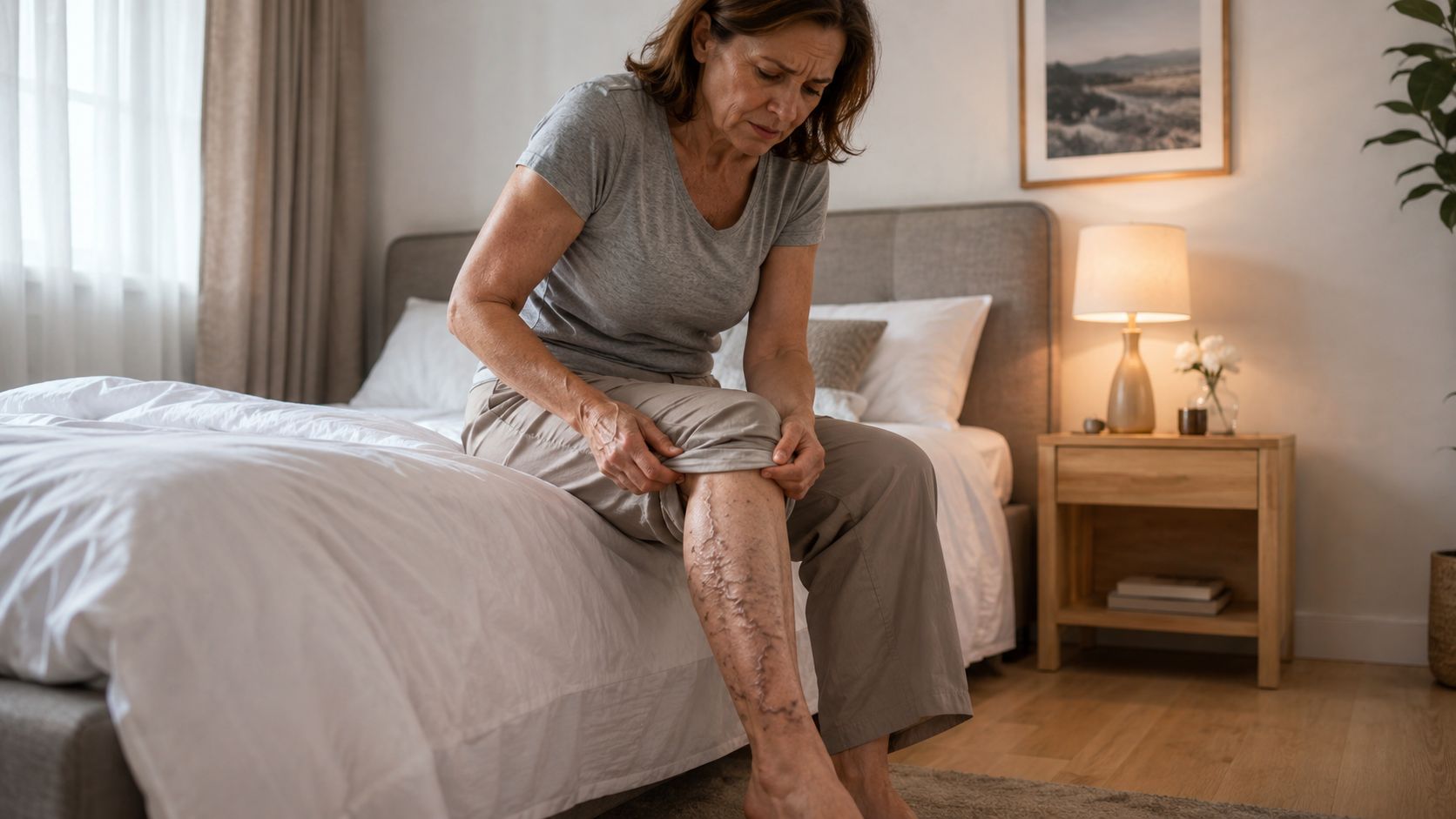
These symptoms are more than a cosmetic complaint. The clinical evidence for Varithena specifically describes improvement in heaviness, aching, swelling, throbbing, itching, symptoms, and appearance when the wrong veins are treated (Varithena clinical evidence). That matters because many patients come in hoping for less visibility, then discover the core problem is the daily discomfort that keeps returning.
Practical rule: If the main issue is how the legs feel at the end of the day, not just how they look, the conversation should focus on vein function, not appearance alone.
Readers often worry that choosing a foam treatment means choosing a “small” or less serious fix. That's the wrong frame. Varithena was developed for diseased veins that are causing reflux, including veins above and below the knee, so it's designed around symptom relief at the source rather than a surface-only touch-up (Varithena clinical evidence). For a plain-language overview of vein symptoms and visible changes, this explainer on varicose veins and spider veins is a useful companion.
The emotional part is real too. People often delay care because they've already decided the treatment will be painful, complicated, or only for severe cases. That hesitation makes sense, but it can keep someone stuck in the cycle of aching legs and repeated self-management. Varithena is worth understanding because it gives vein specialists another way to target faulty veins without heat or tumescent anesthesia.
How Varithena Foam Works Inside the Vein
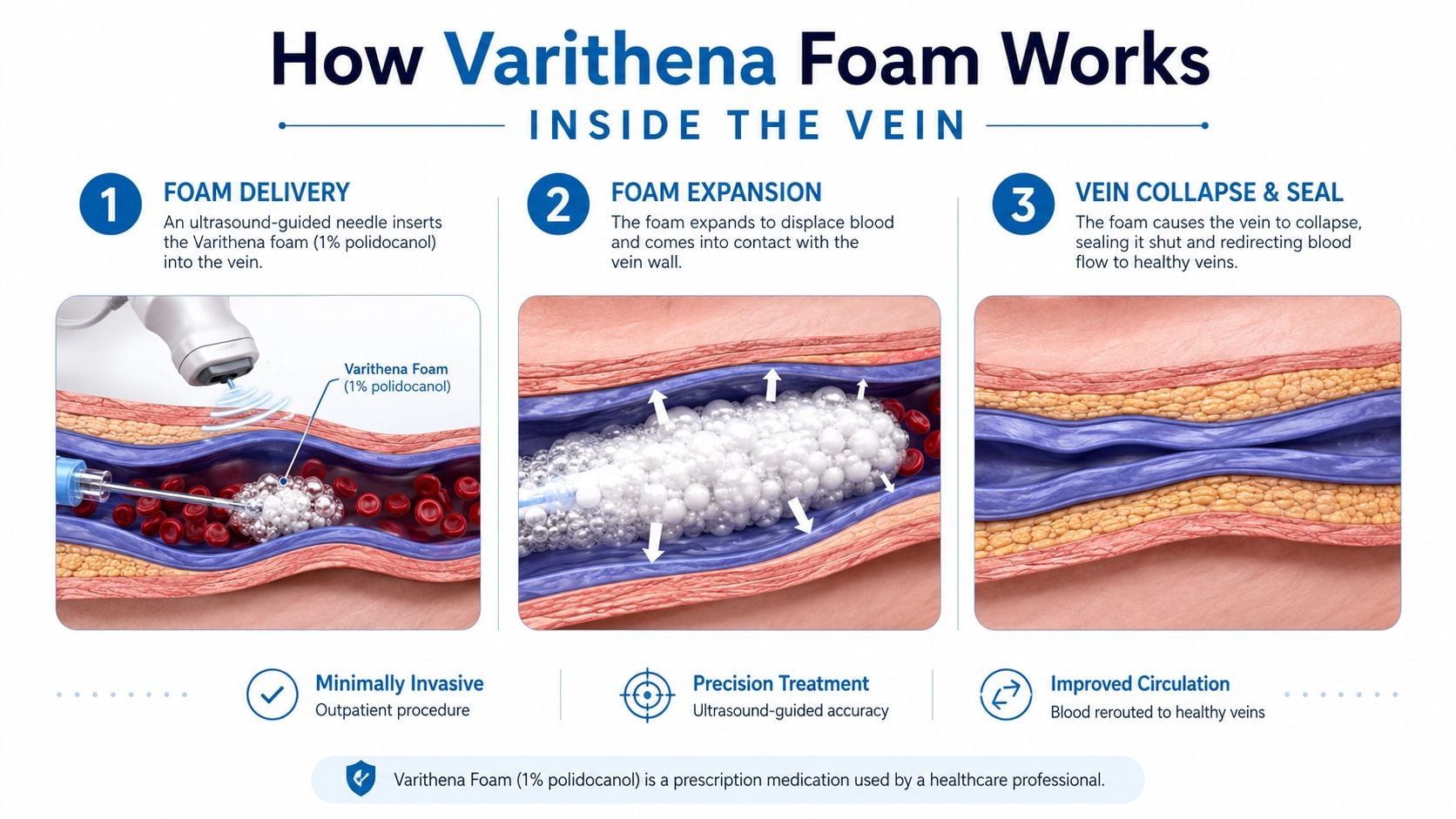
Varithena is polidocanol injectable foam 1%, and the foam part is doing real work. A foam spreads through the inside of a vein differently than a liquid does. It can occupy the space, push blood aside, and keep the medicine in contact with the vein wall long enough to do its job.
Two steps happen inside the vein
First, the foam displaces intraluminal blood. That matters because blood sitting between the medicine and the vein wall weakens the effect. Once the foam is in contact with the inside lining, polidocanol injures the endothelium, the thin inner layer of the vein. The vein then scars shut, collapses, and is gradually resorbed by the body over time.
The easiest analogy is a sponge carrying medicine to the exact surface that needs it. The sponge is the foam, the wall is the faulty vein lining, and the result is a controlled closure rather than a random chemical spread. That's why ultrasound guidance matters so much, the operator has to see where the foam is going and where the vein branches.
Why ultrasound changes the procedure
This treatment is ultrasound-guided, non-thermal, and non-tumescent. In plain terms, that means no heat energy is being used to seal the vein, and no large volume of numbing fluid has to be placed around it. The ultrasound lets the clinician place foam where the faulty vein is running, including areas above and below the knee.
That precision is also why this option can be practical for tortuous or recurrent veins, where a straight catheter path may not be the cleanest route. For practices that need to coordinate follow-up and payer review, a resource on how to optimize payer decisions for revenue can help frame the administrative side of care without changing the clinical goal.
The Numbers That Shape a Safe Procedure
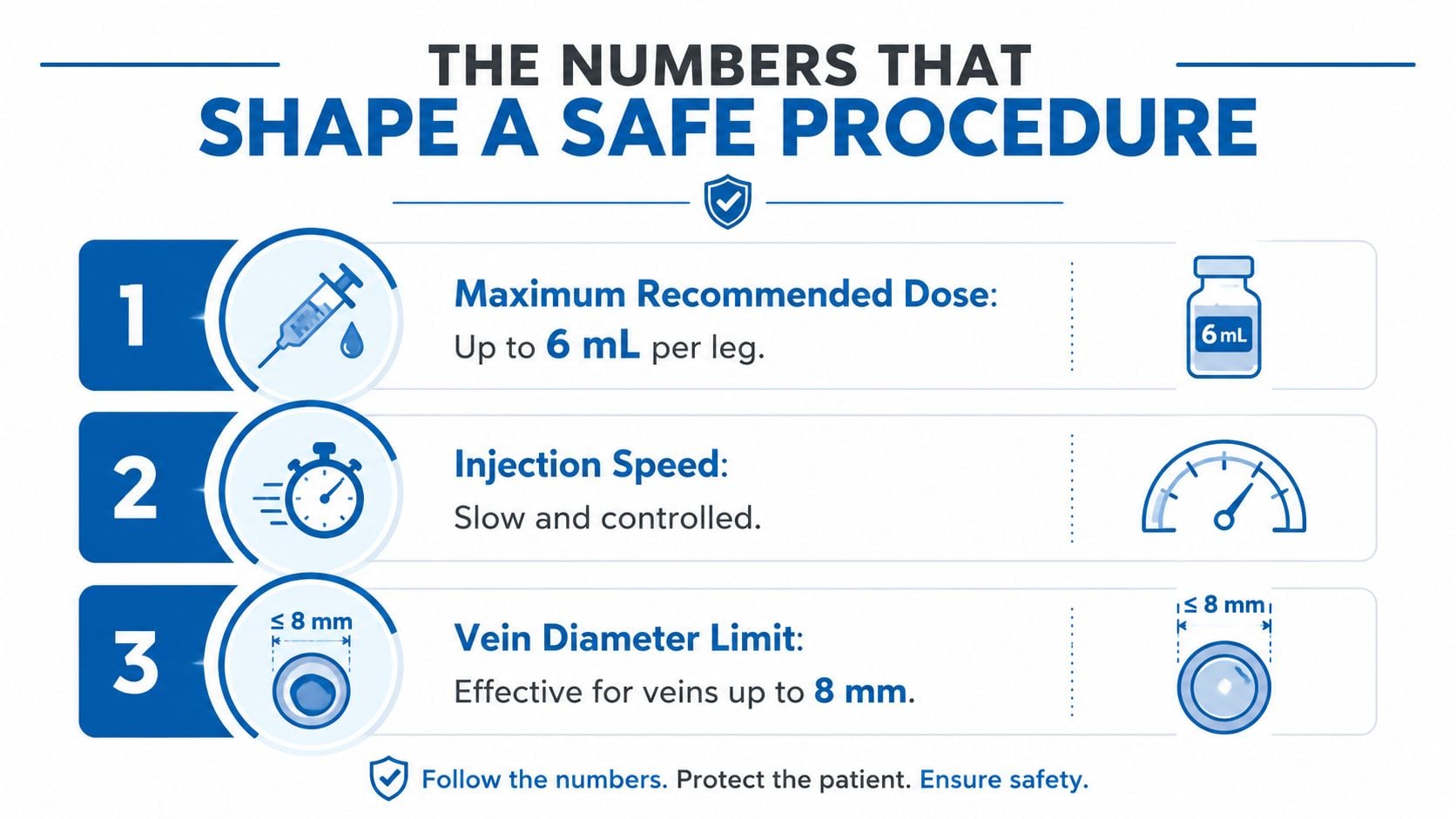
The most important safety story with Varithena is not just that it's minimally invasive. It's that the operator has to stay inside tight, labeled limits. The product label specifies up to 5 mL per injection and no more than 15 mL per session. Those ceilings exist because foam works best when the dose is controlled, not sprayed broadly.
Why each number matters
A per-injection cap helps limit the local chemical load in any one segment of vein. A session cap helps limit overall exposure across the procedure. Together, they force the clinician to work methodically, watching the vein with ultrasound and using only the foam needed to fill the target segment.
There's also a very practical stopping point. Real-world guidance advises stopping injection when the foam is 3–5 cm distal to the saphenofemoral junction, then using compression and walking afterward (EV Today). That rule is there to reduce the chance that treatment extends too close to the deep system while still treating the diseased trunk vein.
Clinician's rule of thumb: Better foam control beats more foam every time. Outcomes depend on careful placement, not volume chasing.
What happens after the procedure
Compression and early ambulation aren't optional extras. They're part of the technical protocol that supports vein closure after the foam is delivered (EV Today). That's why this treatment shouldn't be described as “just a quick injection.” It's a controlled, ultrasound-driven procedure with a defined dose window and a defined post-procedure routine.
Who Is a Good Candidate for Varithena
Good candidacy starts with anatomy, not wishful thinking. Varithena is approved for incompetent great saphenous veins, accessory saphenous veins, and visible varicosities in the GSV system above and below the knee (Varithena patient support). That means the vein map has to show a target that foam can reasonably reach and close.
The symptoms have to match the vein map
People usually arrive because of heaviness, aching, swelling, throbbing, itching, or visible bulging veins. Clinical development data submitted for FDA review showed clinically meaningful improvements in both symptoms and appearance at 0.5%, 1.0%, and 2.0% concentrations, so this is a symptom-directed treatment, not a pure cosmetic procedure (Varithena clinical evidence). That distinction matters when a patient is trying to decide whether the problem is “bad enough” to treat.
The workup decides whether Varithena stands alone
A vein specialist usually starts with a history, exam, and duplex ultrasound mapping to see which veins are refluxing and which surface veins are just being fed by a deeper problem. Sometimes the main trunk vein is treated first, then smaller tributary veins are handled later if they remain symptomatic or visible. That staged approach is common because one closure doesn't automatically erase every surface branch.
Common reasons to look elsewhere include active deep vein thrombosis or a known allergy to polidocanol. Those are not minor details, they change the safety profile and the treatment choice. If the map shows a vein pattern that's too straight and accessible for another technique, or if the main issue is a tiny surface vessel, the plan can shift accordingly.
Varithena Compared to Other Vein Treatments
Varithena isn't a universal answer, and that's a strength. It sits between other approaches as a fit-for-pattern tool, especially when the vein is tortuous, recurrent, or awkward for a catheter-based path. A specialist deciding among options is matching mechanism, anesthesia needs, recovery, and best-fit anatomy.
| Treatment | Mechanism | Anesthesia | Typical Recovery | Best-Fit Anatomy |
|---|---|---|---|---|
| Varithena | Foam sclerotherapy with ultrasound guidance | No tumescent anesthesia | Often outpatient with walking and compression afterward | Incompetent GSV, accessory saphenous veins, visible varicosities, tortuous or recurrent patterns |
| Thermal ablation | Heat closes the vein | Usually more local numbing support | Usually brief downtime | Straighter truncal veins |
| Surgical stripping and ligation | Vein is physically removed or tied off | More invasive anesthesia planning | Longer recovery than office-based procedures | Selected cases when anatomy or prior treatment calls for surgery |
| Liquid sclerotherapy | Liquid irritates smaller veins | Typically minimal | Usually short | Smaller surface veins or spider-type vessels |
Thermal approaches still have a strong role for straightforward truncal veins, but they become less convenient when the vein is winding, superficial, or previously treated. Liquid sclerotherapy is often more appropriate for very small surface veins than for a larger refluxing trunk. Surgical options still matter, but they're usually reserved for cases where anatomy, recurrence, or prior treatment history makes an office-based closure less suitable.
For a broader overview of treatment categories, the clinic's vein treatment options page is a practical starting point.
The patient takeaway is simple. The best choice depends on the map, not the hype. Varithena can be the right answer when ultrasound shows a pattern that foam can treat cleanly and safely, especially when the vein isn't a perfect candidate for heat-based closure.
What Results and Durability Actually Look Like
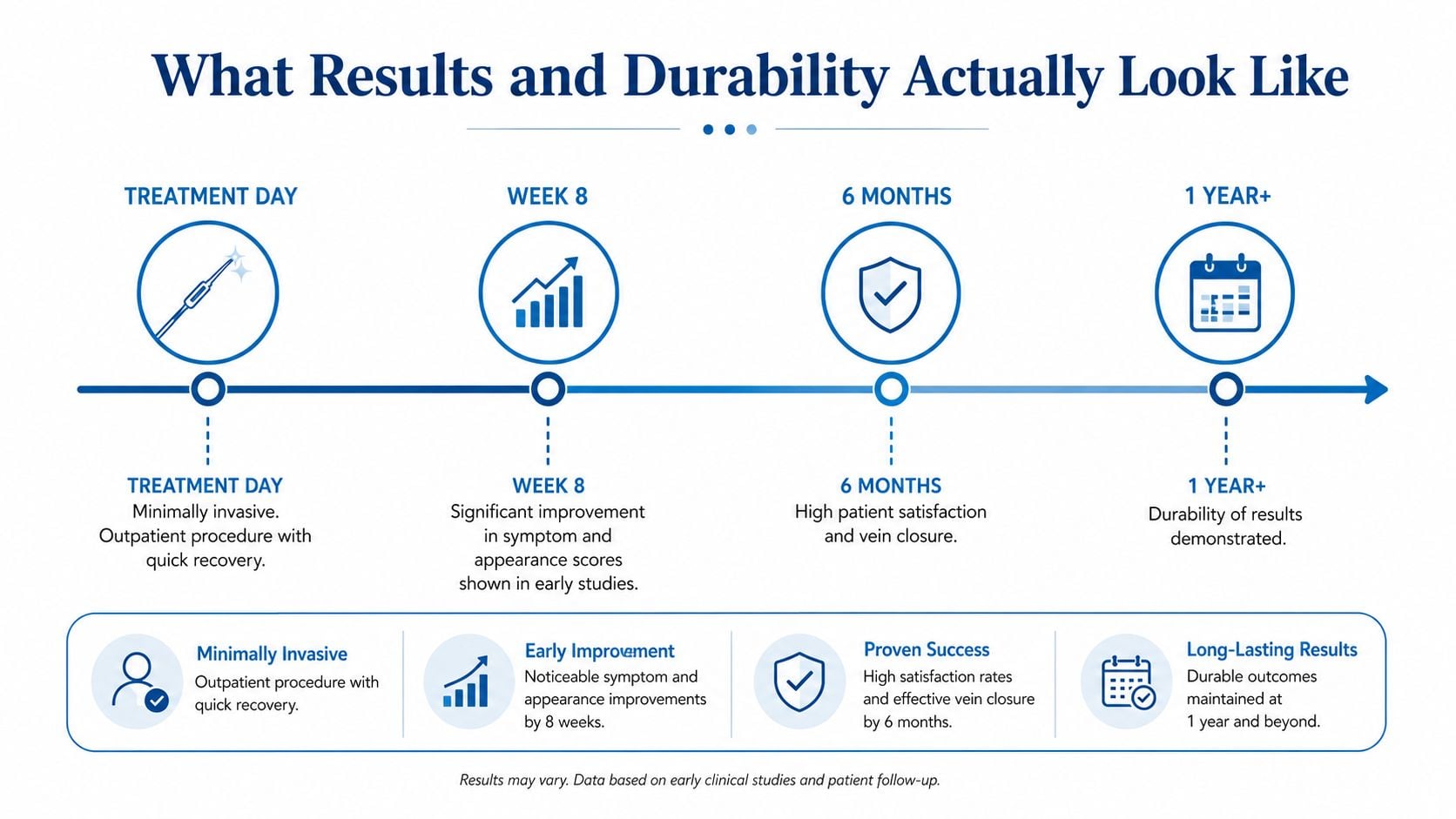
Early placebo-controlled evidence showed statistically significant improvement in varicose-vein symptoms across multiple validated measures, with adverse events generally mild and transient (Varithena clinical evidence). That's encouraging, but it isn't the whole story. The harder question is what happens after the first several weeks, when the appointment is done and the body is still adjusting.
The treated vein doesn't disappear overnight
A consumer monograph notes that the vein is slowly resorbed over several months, not instantly erased. That's important because a leg can feel better before the vein has fully faded, and visible improvement can continue after the first follow-up window. Patients sometimes expect one dramatic change, but the body's cleanup process is slower than the procedure itself.
Durability is promising, but follow-up still matters
The publicly accessible evidence base is still dominated by short follow-up and placebo-controlled trials, so the honest answer on long-term recurrence is that monitoring matters. The FDA approval was supported by two randomized, multicenter controlled trials, which established efficacy and durability well enough for approval in 2013 (Varithena clinical evidence). But the label also allows for additional treatment depending on the number and size of veins, which tells patients not to assume every vein pattern ends with one visit (Varithena patient support).
A practical expectation is staged improvement, not instant perfection. Some veins close, some branches still need follow-up, and the plan can evolve with the ultrasound findings.
That's why a good outcome conversation includes three parts, how symptoms change, how the visible veins settle, and whether any residual tributaries need another procedure. A 30-second read on patient treatment-plan examples can also help patients understand why staged care is normal in vein medicine. Real durability is less about a miracle fix and more about building a plan that can be checked, adjusted, and completed thoughtfully.
Benefits, Risks, and When to Choose Another Path
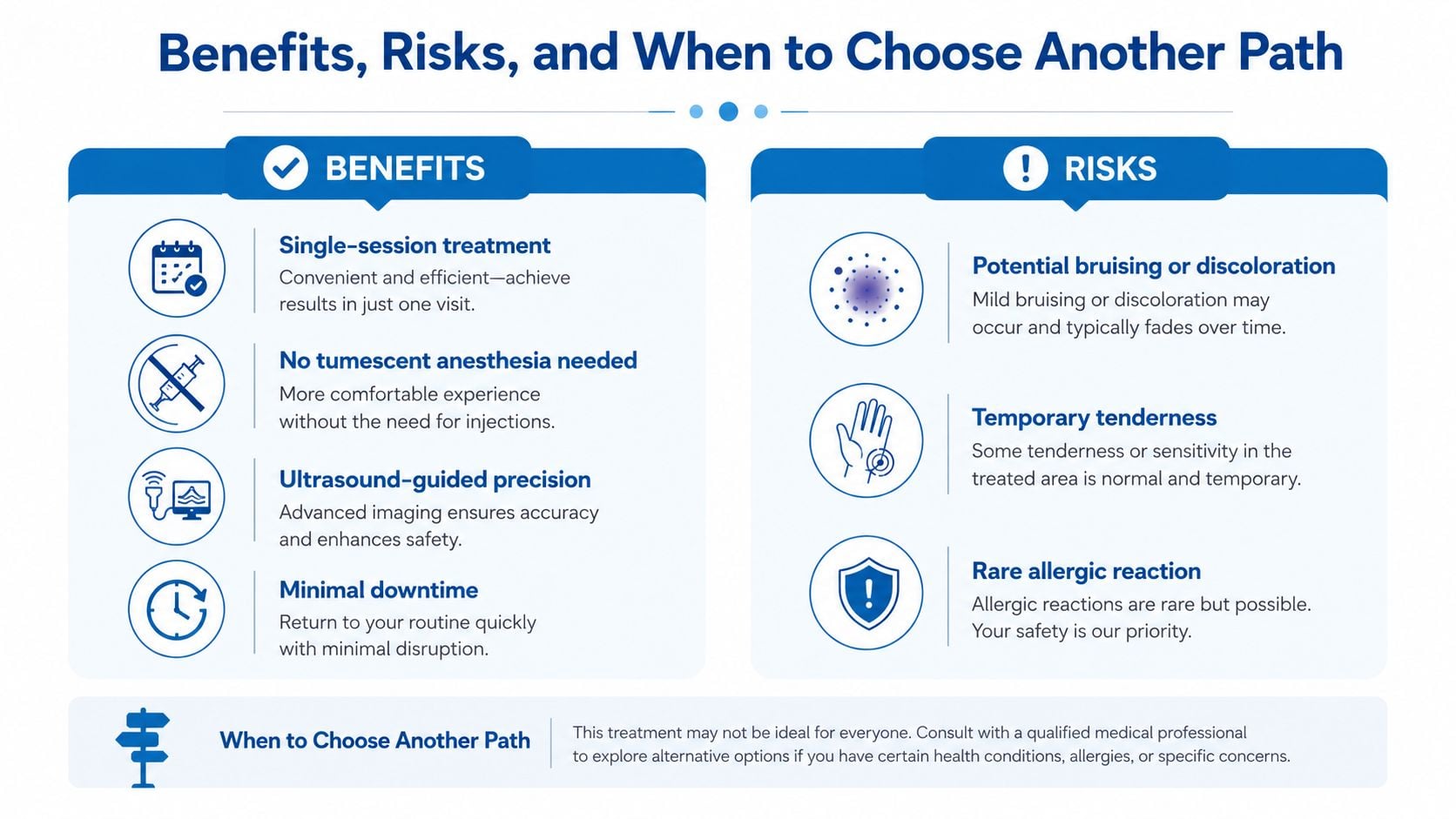
The best reason to consider Varithena is that it can match symptom relief with a controlled office procedure. Patients may value the lack of tumescent anesthesia, the ultrasound precision, and the fact that treatment is often completed in a single visit, even though additional sessions may still be needed depending on vein count and size (Varithena patient support). It's especially appealing when the symptoms are heaviness, aching, swelling, throbbing, itching, or appearance concerns that have not improved on their own.
Benefits and tradeoffs belong on the same page
The downside list should be discussed just as plainly. Bruising, transient discoloration, and tenderness are expected possibilities. Superficial phlebitis can happen, and there is a small but real risk of deep vein thrombosis, which is why the injection limits and junction-stop rules exist in the first place (Boston Scientific brief summary, EV Today).
When another path makes more sense
Varithena is not the right choice if there is a known allergy to polidocanol or active deep vein thrombosis. Some patients do better with thermal ablation, surgery, or simpler conservative care if the vein pattern, medical history, or symptom burden points that way. The right answer is the one that fits the anatomy and the risk profile, not the one that sounds easiest.
Your Next Steps and Common Questions
A smart next step is a vein evaluation that includes duplex ultrasound, a symptom review, and a discussion of whether the main vein, the tributaries, or both need treatment. Varithena often fits best as part of a broader plan, not as a stand-alone promise. That's especially true when the vein map suggests staged care or follow-up after the first closure.
If the consult feels rushed, the wrong questions probably weren't asked. A patient should leave knowing whether one session is likely, whether more treatment may be needed because of vein count or size, and how compression and walking fit into the plan. A clear conversation about follow-up is part of good care, not a sales tactic.
For patients who want a simple way to compare how a plan should be presented, it can help to browse Patient Talker LLC guides and look at how treatment plans are explained in plain language. That makes it easier to spot whether a clinic is discussing anatomy, staging, and aftercare, or just offering a broad claim.
Common questions patients ask
Is Varithena a one-time treatment?
Sometimes, but not always. The label allows for additional treatment depending on the number and size of veins, and residual tributaries may need follow-up.
How soon do symptoms improve?
Early studies showed improvement by week 8 in symptoms and appearance, and some people feel lighter sooner, but the visible response keeps evolving as the vein is resorbed (Varithena clinical evidence).
What activity limits apply?
Compression and walking are part of the protocol, and early ambulation is encouraged after the procedure (EV Today).
When should a specialist referral make sense?
When legs ache, swell, itch, or throb regularly, or when visible veins are getting worse and basic compression hasn't solved the problem. A vein-focused consult can sort out whether Varithena, another closure method, or staged treatment is the better fit.
For a vein evaluation with a team that can review symptoms, ultrasound findings, and treatment options in one place, schedule an appointment through the clinic's booking page.
A CTA for Interventional Pain Management.