
You wake up and the neck pain isn't the only thing that gets your attention. A hand feels tingly, a coffee cup seems heavier than it should, and turning to back out of the driveway sends a sharp line of pain down the arm. That's the moment many people start asking whether ACDF spine surgery is the answer, or whether the problem needs a different kind of care.
The question isn't whether ACDF can work in general. It's whether the pain, numbness, weakness, or balance change fits the kind of nerve compression this operation is designed to treat, and whether the expected benefit is worth the trade-offs. That decision starts with understanding what the surgery does, what recovery looks like, and why the number of levels fused matters so much.
Table of Contents
- When Neck Pain Stops Being Just Neck Pain
- Who Surgeons Recommend ACDF For
- Inside the Operating Room
- Realistic Benefits and Honest Risks
- Recovery Timeline and What Changes With More Levels
- Alternatives Worth Considering First or Instead
- Why a Multidisciplinary Spine Center Changes the Path
- Questions Patients Rarely Ask but Should
When Neck Pain Stops Being Just Neck Pain
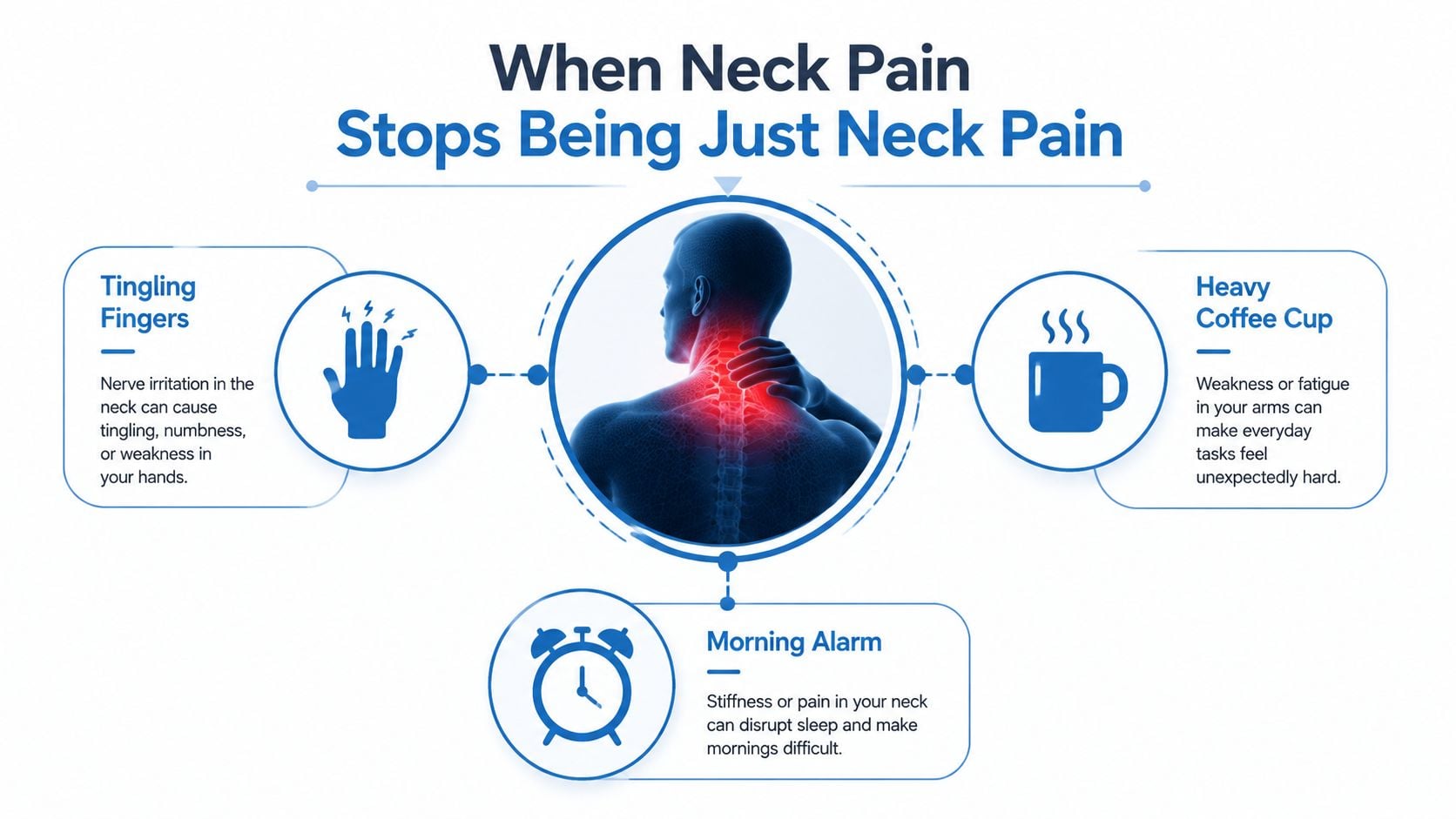
The neck itself is often only part of the problem. A worn disc, a herniation, or a bone spur can press on a nerve root or the spinal cord, and the symptoms show up somewhere else, usually in the shoulder, arm, hand, or walking pattern. That's why a person can come in saying “my neck hurts,” when the bigger issue is that the nerve is being squeezed.
ACDF stands for anterior cervical discectomy and fusion. Anterior means the surgeon reaches the spine from the front of the neck, discectomy means the damaged disc is removed, and fusion means the two vertebrae are joined so that segment becomes stable while bone heals. A simple way to think about it is plumbing and brickwork, the blockage gets cleared, then the wall gets rebuilt so the opening stays open and the segment stays steady.
The symptoms that matter most are often not the loudest pain. Tingling in the fingers, a weak grip, pain that shoots below the shoulder, clumsy hand function, or trouble sleeping because every position hurts can all point toward nerve compression that deserves a proper workup. A careful exam and imaging usually come before any surgical recommendation, because an MRI finding by itself doesn't always mean surgery is needed.
Practical rule: the more a symptom behaves like a nerve problem, the more important it is to match that symptom to the right level in the neck before anyone talks about an operation.
That distinction matters because the goal isn't just pain reduction. It's making sure the compressed nerve or spinal cord has room again, while avoiding surgery for pain that isn't coming from the cervical spine in the first place. A patient-facing overview of neck pain evaluation can help frame that first step, including when symptoms deserve a specialist visit, and a concise resource is available through this neck pain guide.
For people who want a broader overview of when surgery enters the picture, Cincinnati injury firm's surgical intervention advice reflects the same basic idea, surgery belongs after the cause is clear, not before.
Who Surgeons Recommend ACDF For
ACDF is usually considered when there's a clear mechanical reason to operate. A herniated cervical disc can press on a nerve root and cause arm pain or numbness. Cervical spinal stenosis can narrow the canal enough to affect the spinal cord, which may show up as hand clumsiness, balance trouble, or a heavier, less reliable gait.
The operation is also used when degenerative disc disease keeps causing symptoms despite structured nonoperative care. That matters because many people have degeneration on imaging, but not all degeneration is responsible for the problem. The pattern has to fit the exam, the imaging, and the story the patient tells.
Certain traumatic or unstable conditions can also point toward fusion, because the issue isn't only compression, it's whether the segment can hold together safely. In those cases, the surgeon is often trying to do two things at once, decompress the nerve and stabilize the spine. That is why ACDF is described as a decompression-plus-stabilization operation, not just a “disc surgery.”
The best surgical candidate is rarely the person with the worst scan. It's usually the person whose symptoms, exam, and imaging all point to the same level.
A useful way to think about candidacy is this. If the symptom is mostly neck ache without nerve findings, surgery is less likely to help. If the symptom is arm pain, weakness, loss of dexterity, or signs of spinal cord irritation, the workup becomes more urgent. Imaging, a neurological exam, and a documented trial of nonoperative treatment usually come first, because the surgeon needs to know what problem is being solved and whether the body has already been given a fair chance to improve without an operation.
That's also why not every abnormal MRI leads to a recommendation for ACDF. The scan has to match the person, not the other way around.
Inside the Operating Room
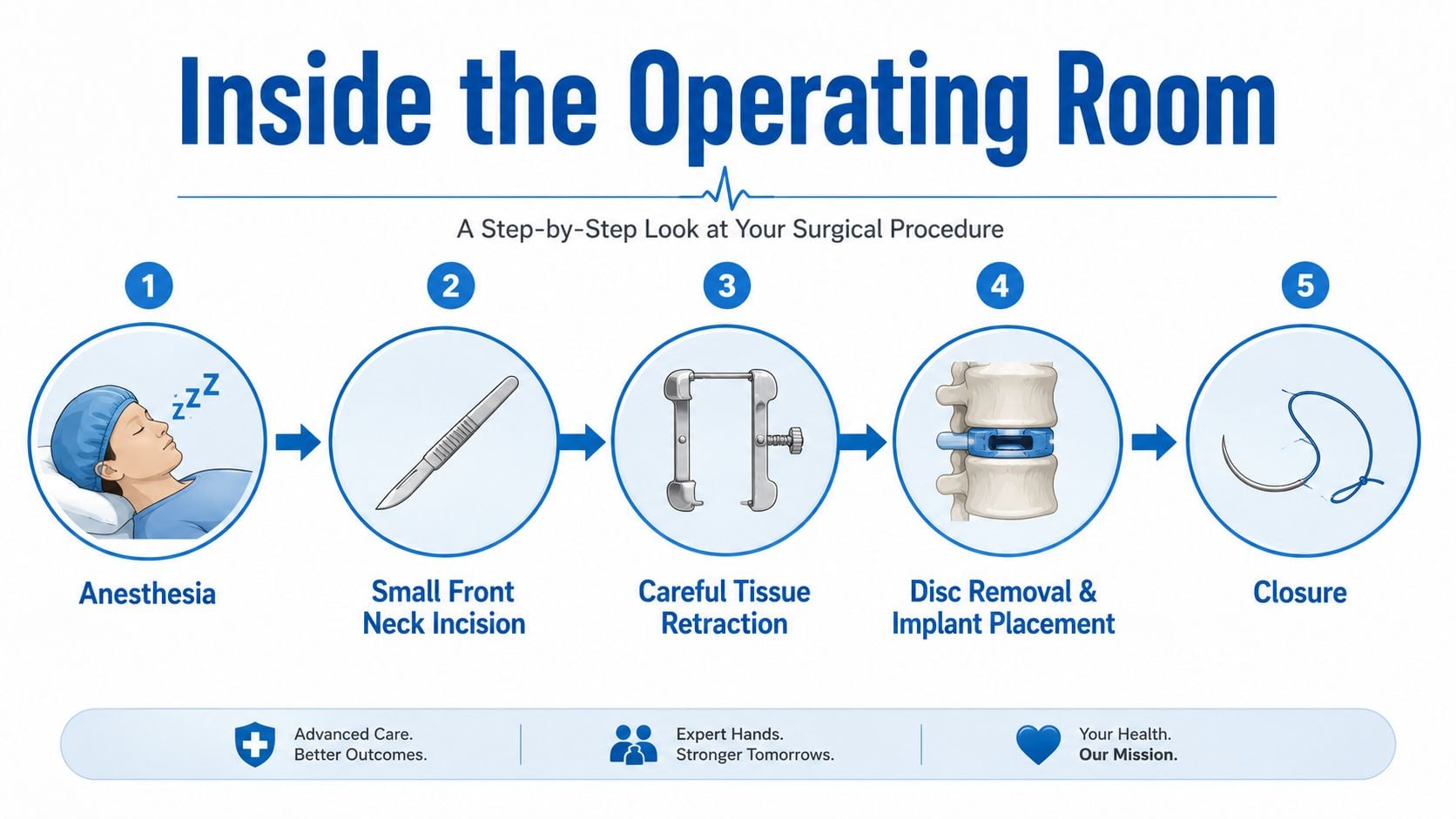
The day starts under anesthesia, so the patient is asleep and not feeling the operation. The surgeon makes a small incision on the front of the neck, then gently moves aside the tissues that protect the airway and the major vessels. That front approach is used because it gives direct access to the damaged disc and bone spurs without having to work through the back muscles.
Once the spine is exposed, the diseased disc comes out. If bone spurs or other compressive tissue are part of the problem, those are removed too, because the nerve or spinal cord needs space again. After that, a graft or cage is placed into the disc space to restore height and support the segment, then anterior plate-and-screw fixation is often added so the level stays stable while fusion matures.
The operation is usually easier for patients to picture when broken into this sequence.
- Anesthesia: the patient sleeps through the procedure.
- Front-neck incision: the surgeon reaches the cervical spine through a small opening.
- Tissue retraction: the airway and vessels are moved carefully aside.
- Disc removal and implant placement: the compressed disc is taken out, then the space is rebuilt.
- Closure: the incision is closed after the segment is stabilized.
The reason surgeons favor the anterior route is simple. It gives direct access to the compressive pathology and allows the surgeon to rebuild the disc space where the problem started. An overview of spinal instrumentation and how implants support the fusion process is available through this spinal instrumentation resource.
The part patients don't always expect is that symptom relief and bone healing are not on the same timeline. The hardware provides immediate stability, but the fusion itself takes much longer to mature. That's why the operating room can feel like the quick part, while the biological healing continues long after the incision is closed.
Realistic Benefits and Honest Risks
A national FinSpine register study found that 76.8% of patients reported symptom improvement at 12 months after ACDF, while 23.2% said their symptoms were unchanged or worse, which is a useful benchmark for an honest preoperative discussion (PMC review). Those figures do not mean every patient follows the same path. They mean many people improve, while a meaningful minority do not get the relief they hoped for.
The odds change as more levels are fused, and patient guides often soften that point. Selected reports describe single-level fusion success reaching up to 97%, while three-level ACDF has been reported around 33% in one summary source, showing how much harder the operation becomes as the construct grows (PMC review). Each added level creates another bone-healing surface, more soft-tissue exposure, and more opportunity for complications.
A 2024 systematic review also provides a clear complication snapshot. It reported dysphagia in 7.9%, adjacent segment disease in 8.8%, pseudarthrosis in 5.8%, recurrent laryngeal nerve palsy in 1.7%, hematoma in 0.8%, and infection in 0.3% (PMC review). Those numbers do not mean a patient should expect all of them. They do mean ACDF is a real operation with real trade-offs, even when it is performed carefully.
| Metric | Rate | Source context |
|---|---|---|
| Patient-reported symptom improvement at 12 months | 76.8% | National FinSpine register study in the cited review |
| Symptoms unchanged or worse at 12 months | 23.2% | National FinSpine register study in the cited review |
| Dysphagia | 7.9% | 2024 systematic review |
| Adjacent segment disease | 8.8% | 2024 systematic review |
| Pseudarthrosis | 5.8% | 2024 systematic review |
| Recurrent laryngeal nerve palsy | 1.7% | 2024 systematic review |
| Hematoma | 0.8% | 2024 systematic review |
| Infection | 0.3% | 2024 systematic review |
Honest counseling beats optimistic wording. A patient should understand both the chance of improvement and the possibility that recovery is incomplete, slower than expected, or limited by the biology of fusion.
The trade-off is straightforward. ACDF can remove pressure and stabilize a painful segment, but it can also leave swallowing discomfort, adjacent-level stress, or incomplete relief, especially when more than one level is involved. Good surgery aims for the best possible correction of the problem that exists, not a guarantee of perfection.
Recovery Timeline and What Changes With More Levels
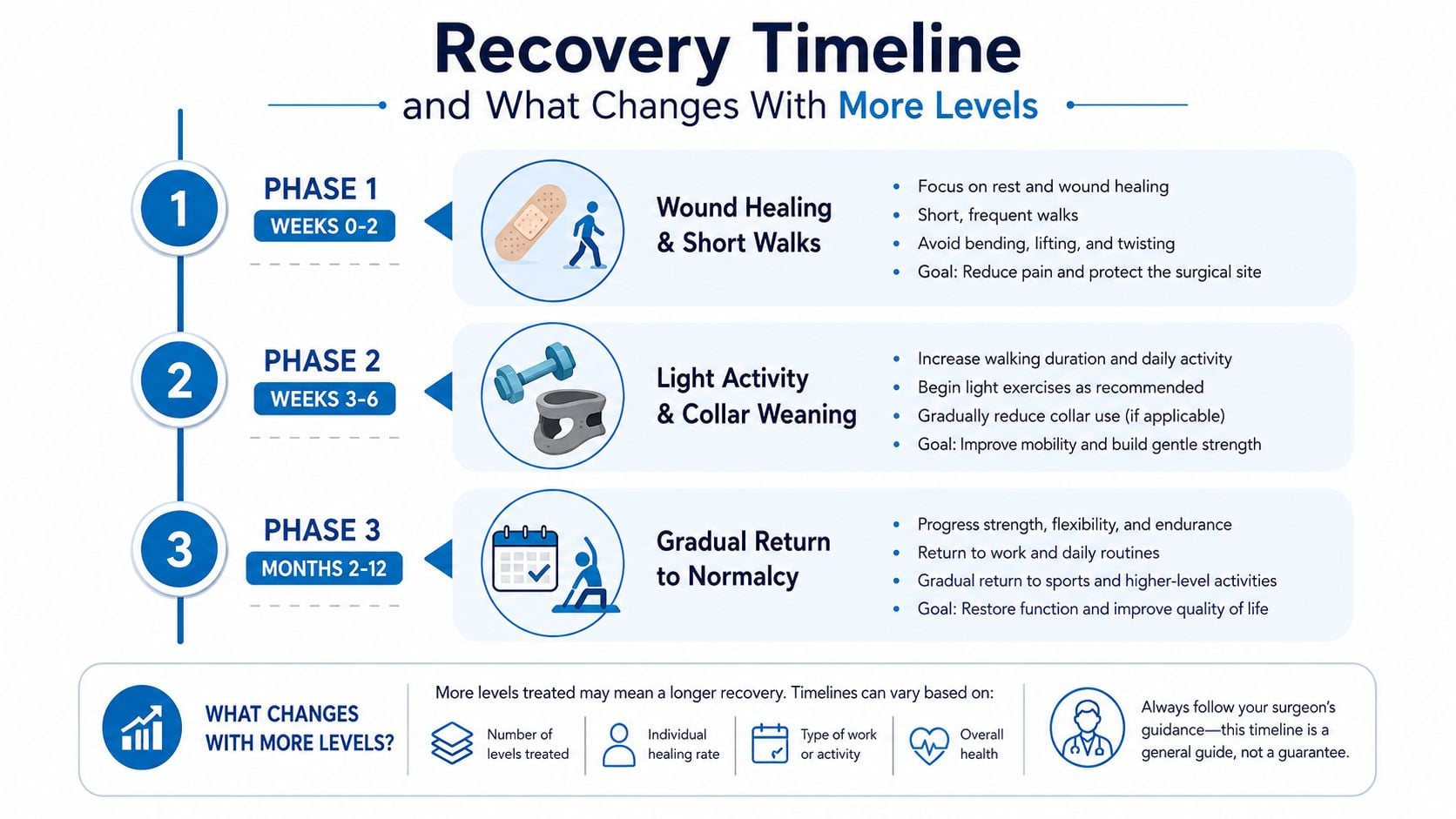
The first phase is protection. During the first two weeks, the incision is closing, short walks matter more than long periods of rest, and the main goal is to avoid loading the neck while the tissues settle. Soreness and throat irritation can show up early, and that can feel worrying if someone expected to feel normal right away.
The second phase usually lasts through weeks three to six. Light activity returns, lifting limits stay in place, and a collar, if one was used, may be reduced under the surgeon's guidance. Many patients feel well enough at that point to do too much too soon, so this is often the time when restraint matters most.
The third phase is the long one. From the second month through the first year, the spine slowly builds a solid fusion, and that process takes time even when the person feels much better. A patient can be back to daily routines before the fusion is fully mature, but the repair still needs protection.
More fused levels change recovery in practical ways. A single-level ACDF usually places less demand on swallowing, pain control, and follow-up than a two-level or multilevel fusion. As the number of levels increases, early swallowing trouble can last longer, monitoring becomes more important, and confidence with daily tasks often returns more slowly. The literature also notes ongoing debate about outpatient observation, with some authors favoring overnight monitoring for more than single-level ACDF while others report selected two-level cases can be done safely as outpatient surgery (PMC review).
That difference is one reason patients should ask a surgeon a simple but direct question.
How many levels are being fused, and what changes in monitoring, pain control, and follow-up because of that number?
A few changes deserve prompt attention rather than a wait-and-see approach. Worsening swallowing trouble, new weakness, fever, trouble breathing, or pain that shifts from improving to sharply worse all need quick review. Recovery is rarely a straight line, but it should trend forward, not backward.
Alternatives Worth Considering First or Instead
ACDF is not the only path for a compressed cervical nerve. Some patients do better with structured physical therapy, especially when the problem is early, stable, or mixed with posture and muscle guarding. Others may benefit from image-guided injections or nerve blocks when the goal is to calm inflammation and confirm the pain generator before surgery is considered.
For chronic neuropathic pain, selected patients may be evaluated for spinal cord stimulation, especially when surgery has already happened and pain persists. That's a different problem from a fresh compressive lesion, but it belongs in the broader conversation because not every neck pain story ends in fusion. The right plan depends on diagnosis, prior treatment, and how much nerve irritation is still active.
Motion-preserving surgery is another relevant option in the right patient. Cervical artificial disc replacement may be considered when the anatomy, age, and degenerative pattern fit, because it aims to preserve movement at the treated level rather than fuse it. More detail on that surgical alternative is available through this artificial disc replacement resource.
What patients usually want to compare is not abstract theory but daily life after treatment.
- Physical therapy: no incision, but slower relief if a nerve is being pinched hard.
- Injections or blocks: useful for diagnosis and symptom control, but they don't remove structural compression.
- Spinal cord stimulation: better suited to selected chronic pain patterns than to obvious mechanical compression.
- Artificial disc replacement: preserves motion in the right candidate, but candidacy is narrower than ACDF.
The choice also shifts with age, smoking status, diabetes, number of levels involved, and how reliably follow-up can happen. A patient with a single-level problem and preserved motion may be a candidate for a motion-preserving approach, while someone with multilevel disease or instability may be steered toward fusion. The right answer is the one that matches the anatomy and the person, not the trend of the moment.
Why a Multidisciplinary Spine Center Changes the Path
A patient's outcome is shaped before and after the operating room, not just inside it. When pain management, orthopedics, and spine surgery sit under one roof, the workup doesn't have to restart every time the plan changes. That matters because a patient can move from diagnosis to injection to surgery to rehab without losing momentum.
A center with seven-day scheduling also changes the experience in a very practical way. Borderline cases don't sit for weeks while symptoms worsen, and the patient doesn't have to chase multiple offices just to get a clear answer. On-site interventional procedures, minimally invasive techniques, and spine surgery options make it easier to match treatment to the problem instead of forcing the problem to fit one department's workflow.
The logistics matter too. Transportation help, insurance navigation, and coordinated imaging review can determine whether the patient gets through treatment or gives up halfway. For people dealing with neck pain, arm weakness, or a possible fusion, that coordination can be just as important as the procedure itself.
The most useful spine center isn't the one that jumps straight to surgery. It's the one that can prove, step by step, why surgery is or isn't the right next move.
Interventional Pain Management fits that model by offering spine surgery services alongside pain management, orthopedic evaluation, and image-guided procedures. For a person trying to sort out whether ACDF belongs in the plan, that kind of multidisciplinary setting can make the next decision clearer and less rushed.
Questions Patients Rarely Ask but Should
Some of the hardest questions are not about the operation itself. They are about access, follow-up, and whether the system around the patient makes recovery easier or harder. A 2024 systematic review found Medicaid beneficiaries had reduced access to ACDF and worse outcomes such as higher readmission and emergency department use, while a 2025 analysis of 67,621 ACDF patients reported that several racial groups had higher comorbidity burdens and less favorable 30-day outcomes than White patients (SAGE review). That means the conversation cannot stop at anatomy.
The number of fused levels should be asked about directly, not assumed. A patient who needs one level is not facing the same recovery profile as a patient who needs two or three, and the monitoring plan may change because of that. It is a little like repairing one hinge on a door versus replacing several. The work, the recovery, and the chance of stiffness are not the same. If the surgeon can explain why outpatient discharge is appropriate, or why overnight observation is safer, the plan is probably more thoughtful.
A few questions are worth bringing to the consult in plain language.
- What exactly makes this patient a candidate for ACDF?
- How many levels are being fused, and why not fewer or more?
- What signs would mean the recovery is veering off track?
- Is there a reason a nonoperative option or a different cervical procedure fits better?
- How do smoking, diabetes, or limited follow-up affect the plan?
Those questions matter because surgery should fit the person, not just the scan. For someone with comorbidities or limited access to follow-up, a more conservative path, or a different cervical operation, may be the safer choice. A multidisciplinary spine center with image-guided procedures, surgical options, and same-week access can help sort that out before the window closes.
If neck pain, arm numbness, or weakness has started to interfere with sleep, work, or simple daily tasks, the next step should be a focused spine evaluation, not guesswork. Interventional Pain Management can help assess whether ACDF, another procedure, or a nonsurgical path fits the problem, and the clearest way to start is to visit Interventional Pain Management and request a consultation.