

A sudden pop in the back of the thigh can change a game, a workout, or a workday in an instant. The person who feels it often tries to walk it off, then discovers that sitting hurts, the leg feels weak, and bruising starts to appear days later. That's usually the moment the questions begin, whether this is a simple strain, whether it needs surgery, and whether waiting will make the outcome worse.
Hamstring tear surgery is not one single operation. It's a group of procedures used for different injuries near the pelvis, especially when the tendon has pulled off the bone and strength, sprinting, or return to sport matter as much as pain relief. The key is matching the treatment to the tear pattern, the amount of tendon retraction, and how much time has passed since the injury.
Table of Contents
- When a Hamstring Tear Changes the Whole Plan
- Anatomy of the Hamstrings and How Tears Are Classified
- When Surgery Becomes the Right Choice
- Open Versus Endoscopic Repair Techniques
- Preparing for Surgery and What Happens in the Operating Room
- Rehabilitation and the Road Back to Activity
- What Outcomes and Risks Look Like in Real Numbers
- Why Nonoperative Care Still Has a Place
When a Hamstring Tear Changes the Whole Plan
The story is usually familiar to athletes and active adults. A sprint starts, a foot slips, or a sudden stretch lands with a sharp pull high in the back of the thigh. Then comes the pop, the limp, the deep ache near the buttock, and the frustration of realizing that this isn't behaving like a routine soreness episode.
The injury that doesn't behave like a simple strain
A regular mid-thigh hamstring strain and a proximal tear are not the same problem. A strain often settles with rehab, but a tear near the ischial tuberosity, the sit bone, can pull the tendon away from its attachment and make strong walking, running, and pushing off much harder to regain. That difference is why some people recover with exercise and time, while others need surgical repair to get their power back.
Patients often get stuck on one question, “Will it heal if it's left alone?” The honest answer is that some injuries will, especially smaller or less retracted tears. Others won't heal in a useful way because the tendon has pulled too far from the bone, and the body can't reliably restore the original attachment under tension.
Practical rule: the more the tendon has pulled away from the ischial tuberosity, the less likely simple rest will restore full strength for sprinting, acceleration, or sport-specific power.
That's why the decision is less about pain alone and more about function. Someone who needs to climb stairs and sit comfortably may have a different threshold than a runner, soccer player, or manual worker who needs explosive hamstring force. The article's central point is simple, hamstring tear surgery is a precision decision, not a default response.
Anatomy of the Hamstrings and How Tears Are Classified
The hamstrings are three separate muscles that work together along the back of the thigh, the biceps femoris, semitendinosus, and semimembranosus. They act like three ropes tied to a single cleat, with that anchor sitting at the ischial tuberosity in the pelvis. If one rope frays, the system may still function. If all three detach, the anchor loses much more of its hold.
The key question is where the injury sits. A mid-belly strain happens farther down in the muscle and usually behaves differently from a proximal avulsion, where the tendon tears off the sit bone. Proximal injuries are the ones that most often lead to a surgery discussion because they disrupt the normal attachment and the power needed for sprinting, acceleration, and strong hip extension.
Partial tears, single-tendon tears, and multi-tendon avulsions
A partial tear means some fibers are still intact, so the tendon has not completely failed. A single-tendon complete tear means one of the three attachments has let go. A multi-tendon avulsion means more than one tendon has pulled free, and the injury becomes more mechanically serious as the number of torn tendons increases.
One important clue in imaging reports is retraction, which describes how far the torn tendon has pulled back from the bone. Retraction matters because a tendon that has drifted away from the ischial tuberosity is harder to restore without tension, and tension makes reliable healing less likely. That is why surgeons do not just ask whether a tendon is torn, they ask how many are torn, how far they have pulled back, and how long ago the injury happened.
A report that says “proximal avulsion” should prompt a real discussion about function, not just pain control. The words matter because they tell the care team whether the tendon still has a realistic path back to the bone.
When Surgery Becomes the Right Choice
The decision for surgery usually starts with a simple scene, a runner or field athlete feels a sharp pull high in the back of the thigh, then finds that sprinting, accelerating, or driving the hip backward feels weak or impossible. That pattern raises concern for a proximal hamstring tear, especially when the tendon has pulled away from the ischial tuberosity, the bony seat bone where the hamstrings attach.
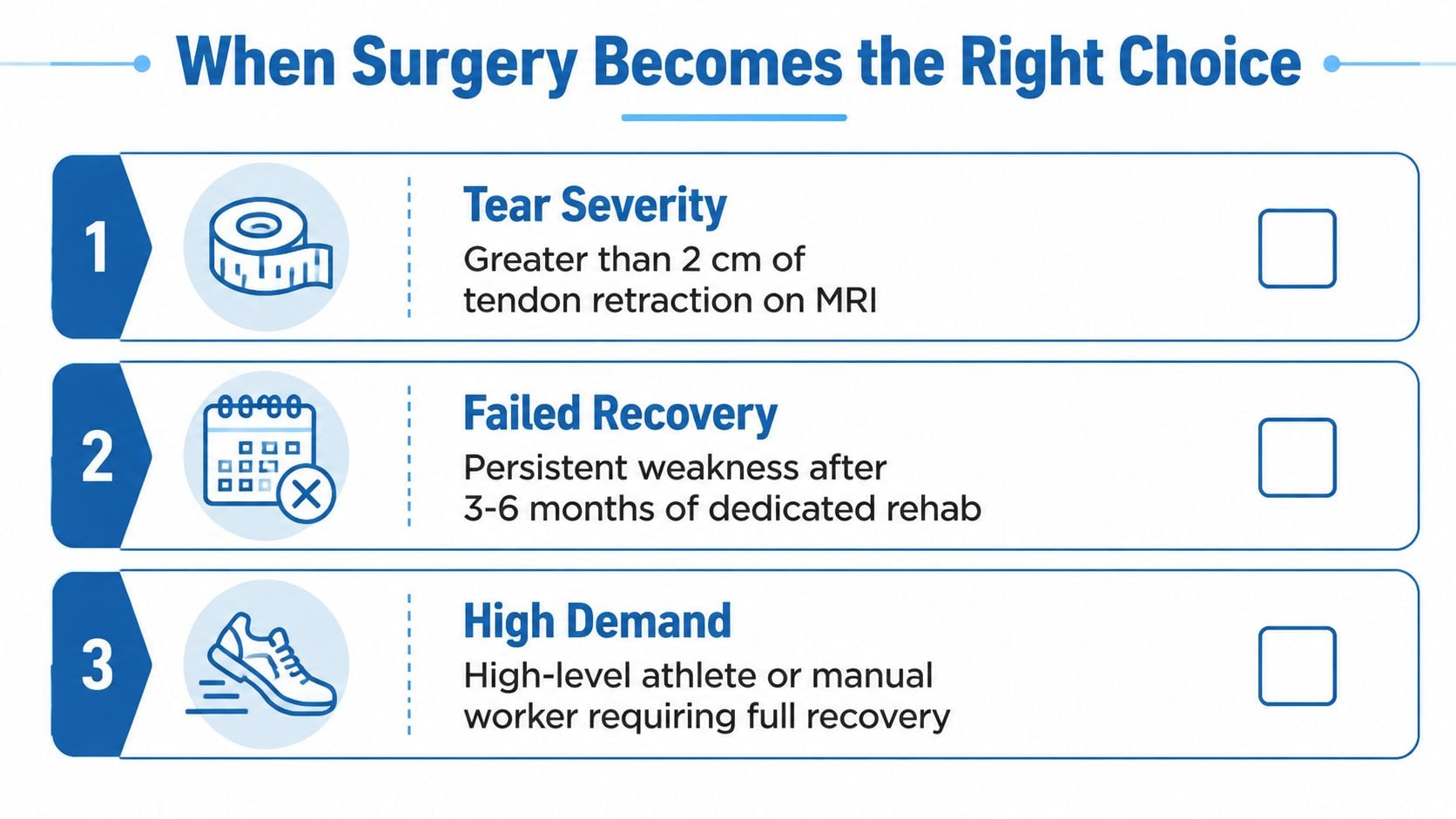
Surgeons usually look at more than pain alone. The practical threshold often includes more than 2 cm of tendon retraction in a two-tendon tear, and all three-tendon tears are commonly repaired because the tendon ends may not sit back on the bone with enough tension for dependable healing. Mass General's hamstring repair guide explains that once the tendon has pulled back, restoration becomes harder and the repair can be under more strain.
The right question for a surgeon goes beyond whether surgery is needed. It also addresses how retracted the tendon is, how many tendons are involved, and whether the patient is still in the early repair window.
Why timing matters so much
Timing changes the repair almost as much as the tear pattern does. Proximal repairs are usually easiest within the first 2 to 3 weeks after injury, before scar tissue forms and before the tendon retracts farther from its attachment site Mass General's hamstring repair guide. In that early phase, the tendon still behaves more like a fresh rope that can be guided back to its anchor point.
A delayed tear can still be treated, but the operation tends to be more complex. Scar tissue can tether the tendon, the muscle can shorten, and the sciatic nerve may sit closer to the repair field, which makes dissection more delicate. Two people can have the same label in an imaging report and still receive different recommendations because one was seen right away, while the other was evaluated after the tear had settled into a chronic pattern.
Pain relief matters, but it is only part of the decision. The deeper issue is whether the tear is likely to recover enough strength and length for sprinting, cutting, climbing stairs, or returning to a sport that depends on explosive hip extension. For patients who still want high-level function, the conversation has to center on tendon position, number of tendons, and how long the injury has been present.
For a closer look at how endoscopic procedures fit into that discussion, see this overview of endoscopic surgery.
Open Versus Endoscopic Repair Techniques
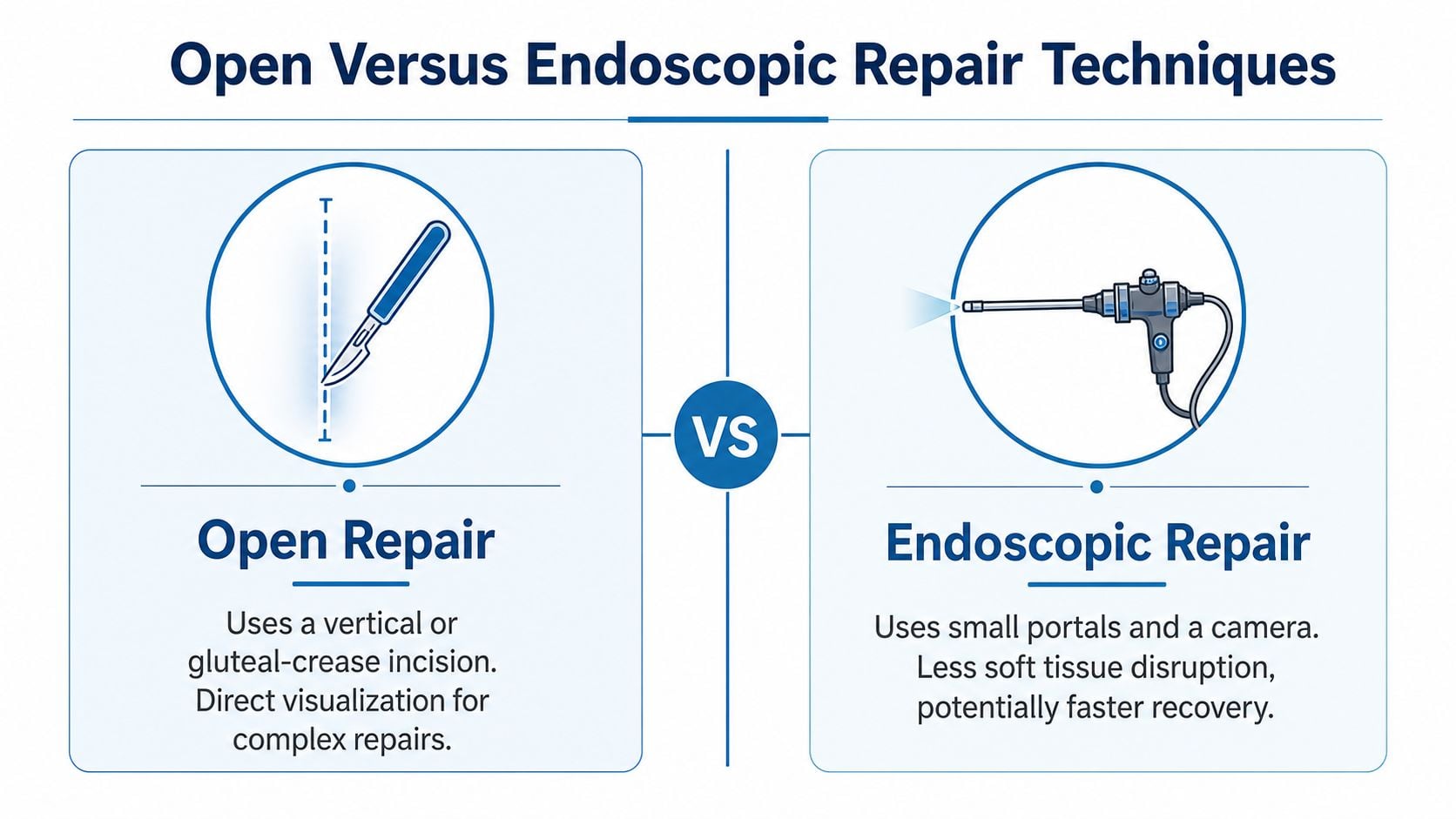
A patient with a proximal hamstring tear may hear two repair options in the same conversation. Both are trying to do the same job, restore the tendon origin on the ischial tuberosity, but they reach that target in different ways. Open repair gives the surgeon wider exposure, while endoscopic repair uses smaller portals and a camera to limit tissue disruption in selected cases.
What the surgeon sees and why it matters
Open repair commonly uses a vertical or gluteal-crease incision that may extend 10 to 15 cm if the tendon has retracted and needs mobilization. That wider exposure gives direct access to scarred or difficult tears, which matters when the anatomy has changed after the injury has settled into a chronic pattern PMC review of proximal hamstring repair techniques. Endoscopic repair typically uses 2 to 3 small portals around the ischial tuberosity and gluteal crease under fluoroscopic guidance.
A prone or flexed-knee position helps relax the hamstrings and may reduce sciatic nerve tension during repair, especially in chronic tears where scar tissue is part of the picture. That positioning sounds minor, but it reflects a larger principle, the surgeon is balancing access, tendon mobility, and nerve safety throughout the case.
The choice between open and endoscopic repair comes down to a trade-off. Open repair provides wider exposure for complex mobilization, while endoscopic repair minimizes tissue disruption through smaller incisions. A surgeon's recommendation usually reflects the tear pattern, how much tissue has to move, and how close the sciatic nerve is to the repair field.
For readers who want a closer look at minimally invasive concepts, this endoscopic surgery resource explains why smaller access does not automatically mean simpler anatomy.
The most important technical goal is not the size of the incision. It is restoring the tendon to the bone safely, without putting the nerve or the repair under unnecessary tension.
Preparing for Surgery and What Happens in the Operating Room
Preparation starts with imaging and ends with a plan that matches the tear, the person, and the timeline. MRI is the key study because it shows how many tendons are torn, how far they've retracted, and whether the injury still looks acute or has become chronic. That information is what guides whether the case is repairable now, repairable later, or better treated without surgery.
The day before and the day of the procedure
Before surgery, the team reviews functional demands, medical problems that might affect anesthesia or wound healing, and any nerve symptoms. The goal is not just to confirm the tear, but to make sure the person is ready for a repair that will require careful rehab afterward. If symptoms include pain, numbness, or tingling down the leg, the surgeon pays particular attention to the sciatic nerve.
On the day of surgery, the patient is usually placed under anesthesia and positioned prone, often with the knee flexed to relax the hamstrings. The surgeon then mobilizes the tendon, protects the sciatic nerve, places suture anchors into the ischial tuberosity, and secures the tendon back to bone before closing the layers. The procedure can be done as a same-day operation or with an overnight stay, depending on the case and the care plan.
For patients who want a general look at how nerve-targeted care fits into orthopedic planning, this nerve block resource provides useful context for the role of pain control around procedures.
The operation is less about “stitching muscle back together” and more about recreating a stable tendon-bone attachment while protecting the nerve that runs nearby.
Rehabilitation and the Road Back to Activity
Recovery after hamstring tear surgery follows a sequence, not a single deadline. The repaired tendon has to heal back to bone before it can tolerate force, and each phase of rehab serves a different job. Early on, the focus is protection. Later, it shifts to restoring motion, then strength, then speed and sport-specific control. The calendar matters, but function is the true marker of progress.
A realistic progression after repair
The first phase usually centers on protection. Bracing, protected weight-bearing, and swelling control dominate the first two weeks because the repair is still fragile and the tissue needs quiet time to settle. That can feel frustrating, especially for athletes who want to test the leg early, but this is the period that protects the repair while the tendon begins to knit to the ischium.
Between weeks 2 and 6, rehab often adds gentle range of motion and isometric activation, which means the muscle contracts without large joint movement. That approach keeps the hamstring engaged without asking it to pull hard across the healing site. From weeks 6 to 12, the plan commonly shifts toward closed-chain strengthening and stationary biking, since those movements build load tolerance while limiting sudden stress. Later phases add running mechanics, eccentric loading, and plyometrics, usually from months 3 to 5, as the tendon and muscle relearn how to handle faster, more demanding work again.
Athletes should expect the average return to sport to be about 6.5 months after surgery, based on the 2022 systematic review in Bone & Joint Journal that pooled 35 studies and 1,530 surgically repaired hamstrings Bone & Joint Journal review. That same review reported 84.5% return to sport overall and 92.6% patient satisfaction after surgery Bone & Joint Journal review. In plain terms, many patients do well, but getting back to sprinting, cutting, or explosive sport work still depends on the tear pattern, the quality of the repair, and how closely rehab is followed.
Nutrition also plays a supporting role. For people trying to organize meals around the demands of rehab, Gym Snack muscle recovery foods is a helpful starting point. Food cannot replace the repair, but it does matter while strength is being rebuilt and training volume starts to rise again.
What Outcomes and Risks Look Like in Real Numbers
A patient deciding on hamstring tear surgery usually wants a simple answer, but the picture depends on function. A repair can restore the tendon's attachment and give the muscle a better mechanical base, especially after an acute proximal avulsion where the tendon has pulled away from the bone. In chronic degenerative tears, the goal is often more modest, because scar tissue, tendon shortening, and delayed healing can make the repair more difficult.
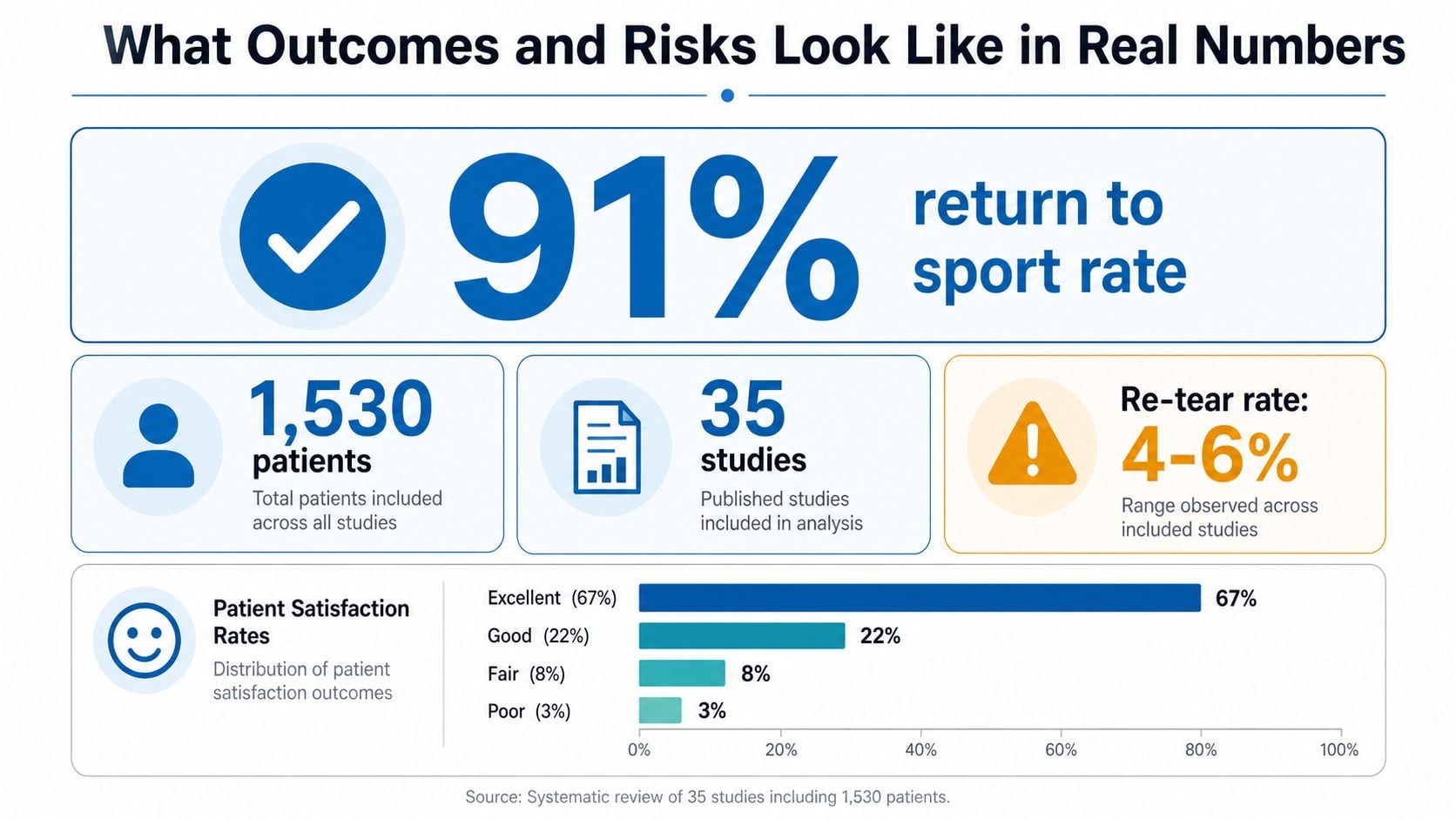
The strongest published summary still comes from the 2022 Bone & Joint Journal review, which pooled 35 studies and 1,530 surgically repaired hamstrings. It reported 92.6% patient satisfaction, an 84.5% overall return-to-sport rate, and a mean return at 6.5 months. The same review also described a 1.2% re-rupture rate at a mean follow-up of 3.2 years and 3.5% sciatic nerve dysfunction.
What those numbers mean in plain language
Those results show that modern repair often works well, but it is not a guarantee of full athletic recovery. Many people feel satisfied because they regain walking tolerance, sitting comfort, daily strength, and confidence in the leg, yet the ability to sprint, cut, or tolerate explosive sport work still depends on the tear pattern, the quality of the repair, and how carefully rehab is carried out. Re-injury appears uncommon in the published review, while nerve irritation remains a real trade-off because the sciatic nerve sits close to the surgical field.
Patients also need a clear view of the limits. A tendon can heal and still leave some loss of power, especially in chronic cases or in athletes who need repeated max-speed acceleration. That is why the decision should focus on the function that matters most, not pain alone. A repaired tendon may look good on imaging and still fall short if the person cannot sprint, sit comfortably, or trust the leg during sport.
A good surgical result is measured by walking, sitting, sprinting ability, and patient confidence rather than imaging findings alone.
For readers trying to tell a simple muscle strain from a deeper tendon problem, this overview of tendinitis and bursitis can help separate common overuse pain from injuries that need closer evaluation: sore hamstring after running.
Why Nonoperative Care Still Has a Place
A serious hamstring tear does not always move straight to the operating room. Some injuries are better handled first with structured rehabilitation, especially low-grade partial tears, single-tendon avulsions with little retraction, lower-demand patients, and people whose medical history makes surgery a bigger risk. That approach also makes sense when the tendon still has enough contact with the bone to heal without being pulled farther apart by everyday tension.
The key question is not only whether the tendon hurts. It is whether the person can regain the function that matters, such as walking without hesitation, sitting comfortably, or returning to sport without a lasting power deficit. For a recreational runner, that may mean a different answer than for an athlete who needs sprinting, cutting, and repeated acceleration.
When rehabilitation deserves a real trial
A structured nonoperative plan usually begins with symptom control, then moves step by step through motion, walking tolerance, and strengthening. Early care often looks simple, but the logic is deliberate. The tendon and surrounding muscle need time to settle before loading is increased, much like letting a strained rope stop fraying before pulling hard on it again.
That route is often the right choice when the main goal is normal daily activity rather than maximal sprint power. It is also appropriate when surgery would create more risk than benefit for the person sitting in front of the clinician. In those cases, the safest plan may be the one that avoids an operation while still restoring usable strength.
The decision becomes more urgent if the person has persistent flexion weakness after the early recovery period, cannot bear weight comfortably, or develops progressive sciatic-type symptoms. Those findings suggest that the tendon may not be recovering well enough for the patient's real-world demands. A careful re-evaluation should happen before the problem becomes more chronic and less predictable.
For readers sorting out whether a pain episode is a simple muscle issue or something deeper, this overview of tendinitis and bursitis can help separate common overuse pain from a true tendon injury, while learning about a sore hamstring after running can clarify when discomfort crosses into injury territory.
A short checklist helps frame the next step:
- Audible pop with immediate weakness: That pattern deserves same-day evaluation, because it is more consistent with a true tear than with ordinary soreness.
- Large posterior thigh bruise: Bruising down the back of the thigh often points to a more significant injury than a mild strain.
- Sciatic-type tingling or numbness: Nerve symptoms need prompt attention, since the sciatic nerve sits close to the proximal hamstring.
- Inability to bear weight comfortably: That is a strong reason to move from watchful waiting to imaging and specialist review.
A multidisciplinary setting can make this easier because imaging, examination, and treatment planning can happen in one coordinated place. That matters for athletes, manual workers, and anyone trying to make a fast but sensible decision about season timing. For many patients, the best path is not surgery or nothing. It is a coordinated plan that matches symptoms, MRI findings, and functional goals.
FAQ
Is MRI always needed? For a suspected proximal avulsion, MRI is usually the most useful study because it shows tendon number, retraction, and chronicity.
How soon can surgery be scheduled? Timing depends on the tear and local access, but earlier evaluation gives the surgeon more options within the repair window.
Can a season still be planned around surgery? Sometimes, but the schedule has to follow healing and function, not a fixed date on the calendar.
If a recent hamstring injury is still limiting walking, sitting, or sprinting, the next step should not be guesswork. Interventional Pain Management offers coordinated evaluation, imaging review, and treatment planning for musculoskeletal injuries like this, with a team that can help determine whether rehabilitation, procedure-based care, or surgical referral makes the most sense. Visit Interventional Pain Management to get a focused assessment and build a plan around your recovery goals.