
Knee pain after replacement can feel like a cruel surprise. A person may have done the rehab, followed the instructions, and still end up limping, avoiding stairs, or wondering whether another surgery is the only path left. For many patients, the hardest part is not just the pain itself, it's figuring out whether that pain points to a fixable implant problem, a nerve-related issue, or a recovery plan that needs to change.
RFA procedures often enter the conversation because chronic pain after surgery does not always come from the joint hardware alone. Some patients need a diagnostic and treatment pathway that starts with understanding where pain is coming from, what can be done without rushing into another operation, and when a revision surgery makes sense. A clear plan helps people ask better questions, compare options more confidently, and stay active in the decisions that shape their mobility.
Table of Contents
- Introduction to RFA procedures and Knee Revision Surgery
- Understanding Knee Replacement Revision Surgery
- Indications and Diagnostic Workup
- Surgical Revision Options with Case Examples
- Perioperative Management Risks and Outcomes
- Rehabilitation Timeline and Alternative Treatments
- How to Choose the Right Surgeon and Center
- Conclusion and Key Takeaways
Introduction to RFA procedures and Knee Revision Surgery
A patient may sit at the kitchen table months after knee replacement, rubbing the front of the knee and wondering why walking still hurts. The operation was supposed to reduce pain, but now the questions feel bigger than the symptoms. Is the implant loose, is the soft tissue irritated, or is there a pain signal that needs a different kind of treatment?

That is where a stepwise approach matters. Knee revision surgery addresses mechanical problems in a prior implant, while RFA procedures belong to a pain-management conversation that can help patients and clinicians understand whether pain is being driven by nerves, inflammation, or joint mechanics. When people know the difference, they can talk more clearly with the medical team about what needs imaging, what needs examination, and what can be tried before another operation becomes necessary.
Patients usually worry about two things at once, anesthesia and recovery time. Those concerns are valid, and they're easier to manage when the plan is specific instead of vague. The rest of this guide breaks the process into plain language so the choices feel practical rather than overwhelming.
Understanding Knee Replacement Revision Surgery
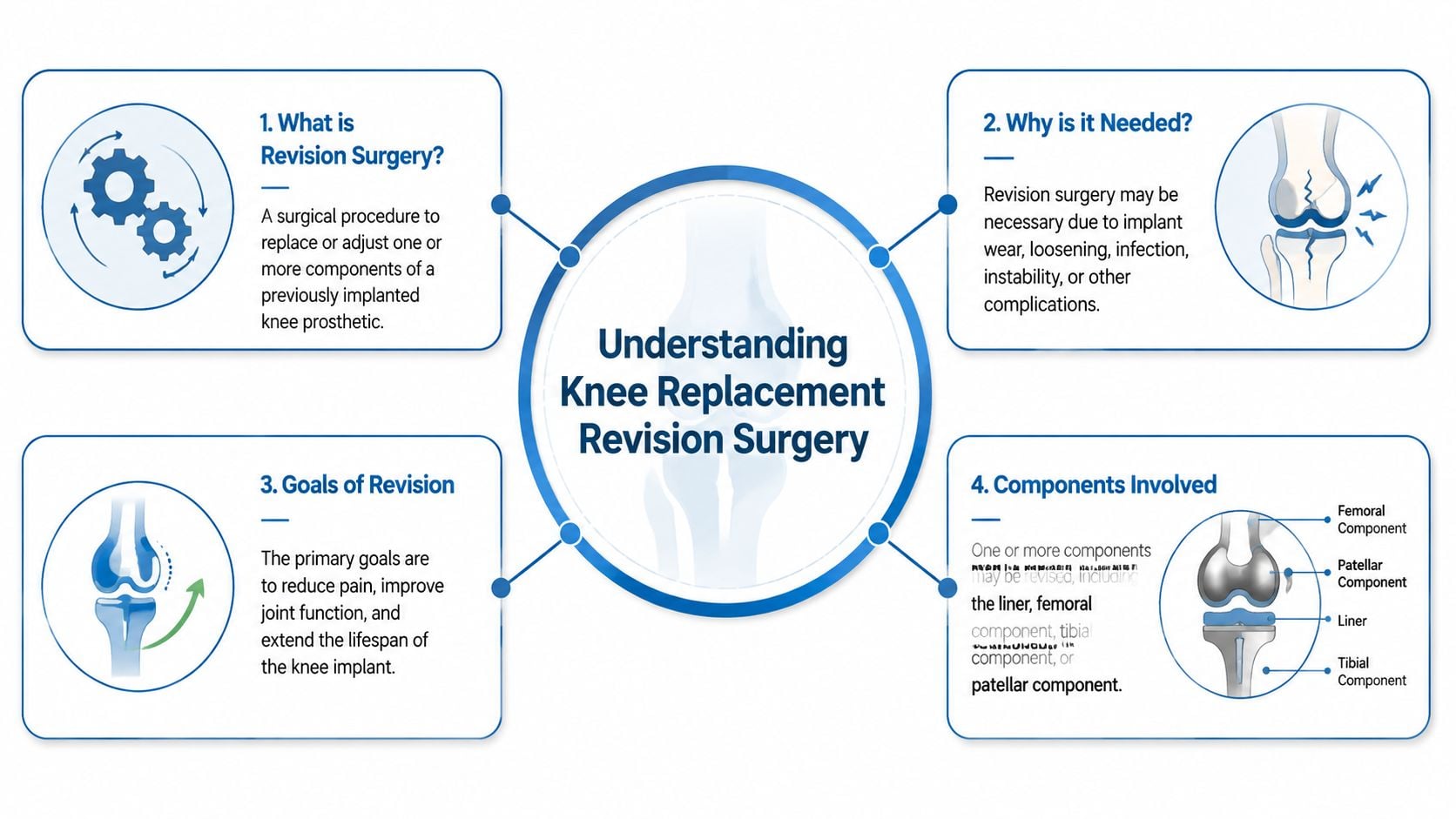
A knee replacement works like a mechanical hinge with living tissue wrapped around it. Over time, parts can loosen, wear down, or stop moving together the way they should, and revision surgery is the process of repairing or replacing those failing pieces. The goal is not to “start over” emotionally, it's to restore alignment, stability, and motion so the knee can function more predictably.
What revision surgery actually means
Revision can involve one part or several parts of the prosthetic joint. In some cases, the surgeon changes only the worn bearing surface. In others, the femoral, tibial, or patellar components need removal and replacement because the support underneath them is no longer dependable. Think of it as fixing a hinge where one screw is loose versus rebuilding the whole frame around it.
The reason revision is more complex than the original replacement is that the surgeon is working around existing scar tissue, altered bone, and a prior implant track. That changes the technical plan. It also changes what the patient needs to ask about, such as how much of the old implant is expected to stay, whether bone grafting might be needed, and how the new parts will be stabilized.
Why the goal is different from the first surgery
Primary knee replacement usually aims to replace a badly damaged joint. Revision surgery tries to solve a problem that has already shown up after the first implant. That might mean correcting loosening, restoring balance, or improving tracking so the knee bends and straightens more smoothly.
A useful way to frame the conversation is this. The first replacement is about building a working joint. The revision is about correcting why that working joint stopped working well.
Indications and Diagnostic Workup
Not every painful replacement needs surgery right away. The medical team first tries to answer a more precise question, what is failing. Revision becomes a serious option when there is evidence of infection, loosening, instability, stiffness, or fracture-related damage that fits the symptoms and examination findings.
What usually raises concern
Pain that worsens with walking, a sense that the knee shifts, new swelling, reduced range of motion, or a change in leg alignment can all trigger further workup. Infection tends to demand urgent attention because it can damage the implant and surrounding tissue. Loosening often shows up as pain with weight-bearing or a feeling that the knee is no longer secure.
The exam matters because symptoms alone can mislead. A patient may describe “pain,” but the source could be mechanical, inflammatory, or referred from another structure. That's why clinicians combine history, physical findings, and imaging instead of making a decision from one clue.
Practical rule: a revision discussion should usually start only after the team has a clear explanation for the pain, not just a description of where it hurts.
Diagnostic tests comparison
| Test | Purpose | Typical Findings |
|---|---|---|
| Physical examination | Checks alignment, stability, swelling, warmth, and motion | Instability, stiffness, tenderness, or signs that point to infection or mechanical failure |
| X-rays | Looks for implant position, loosening, and fractures | Shifting components, radiolucent lines, or fracture changes |
| Laboratory tests | Helps assess possible infection | Abnormal inflammatory markers may raise concern, especially when matched with symptoms |
| Joint aspiration | Evaluates fluid for infection-related clues | Fluid analysis may support or argue against infection |
| Advanced imaging | Clarifies bone loss or component position when standard films are not enough | More detailed views of the implant-bone relationship |
How patients can prepare for the visit
A useful consultation includes a symptom timeline, prior surgery records if available, and a clear description of what makes the knee worse or better. Patients should also ask which findings would make surgery more likely, and which findings would point toward nonsurgical treatment instead. That keeps the visit focused on decisions, not just complaints.
Surgical Revision Options with Case Examples
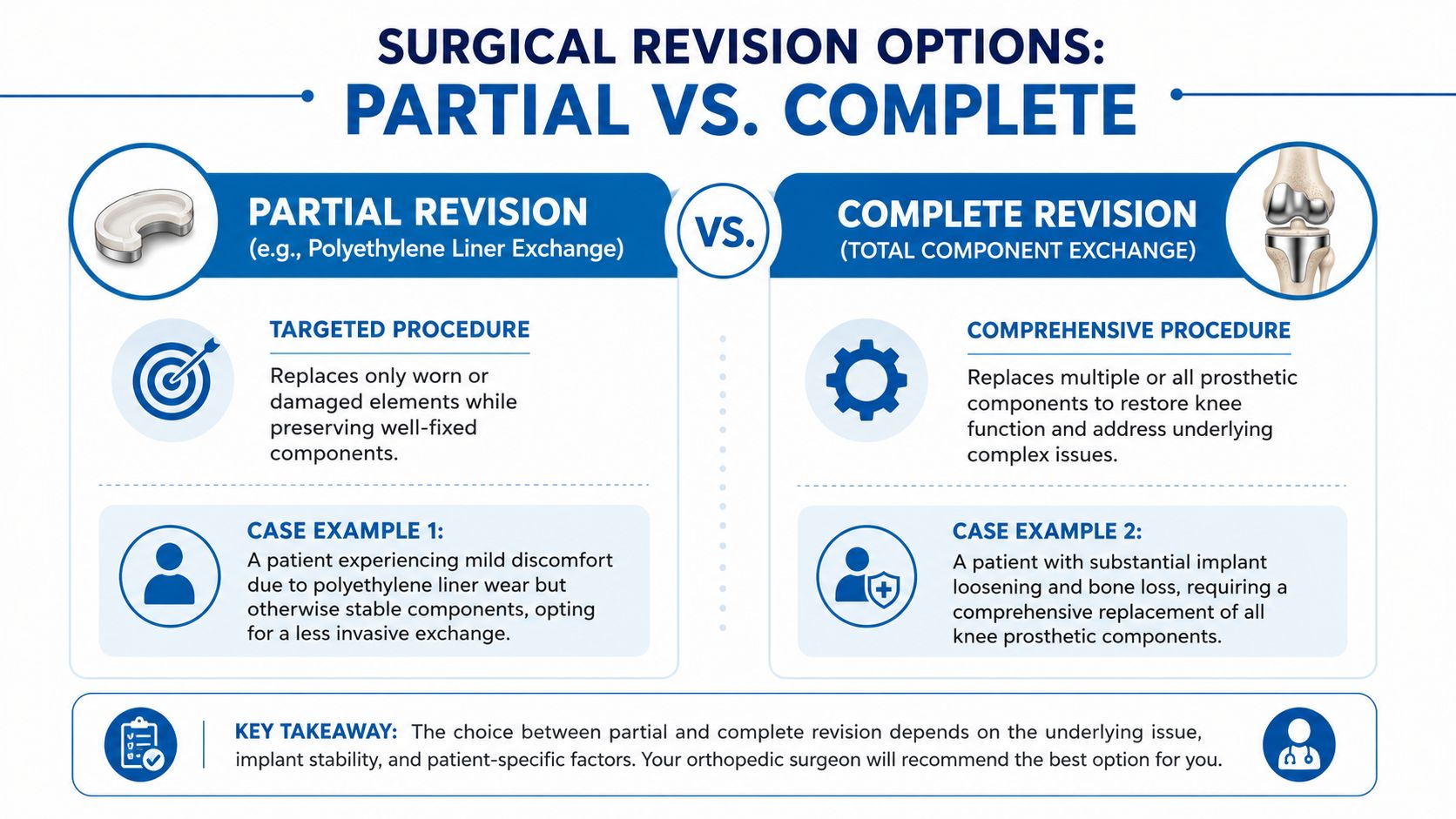
A revision plan is rarely one-size-fits-all. Some knees need only a targeted exchange of a worn liner, while others require a full component revision because several parts are no longer working together. The right choice depends on how many structures are failing, how much bone is left to support the implant, and whether the knee can still be balanced safely.
Partial revision for isolated wear
A partial revision is often considered when the major components are stable and the issue is localized. For example, a patient may have a worn polyethylene liner but no major loosening in the metal parts. In that situation, replacing the liner can address the problem while preserving healthy bone and reducing the scope of surgery.
That kind of decision is attractive when the knee is otherwise well-aligned. It can also shorten the amount of reconstruction needed during the operation, which matters when the goal is to solve a specific mechanical failure without disturbing everything else. For a patient, the key question is simple, which part is failing, and which parts are still sound?
Complete revision for broader failure
A complete revision is more likely when instability, loosening, infection, or multiple failing parts are present. In that setting, replacing all major components gives the surgeon more control over alignment, fixation, and balance. Bone grafting may also be part of the plan if bone stock has been lost.
One anonymized case example is a patient with a stable implant except for a worn liner, who chose a targeted exchange after discussing the trade-offs with the surgeon. Another is a patient with substantial loosening and bone loss, where a full component exchange was needed to rebuild a stable foundation. Those are very different operations, and they deserve different recovery conversations.
Joint replacement surgery planning becomes more manageable when patients ask which pieces are being replaced, what the surgeon expects to leave in place, and how the revised knee will be protected afterward.
The best surgical plan is the one that matches the actual failure pattern, not the one that sounds simplest on paper.
Perioperative Management Risks and Outcomes
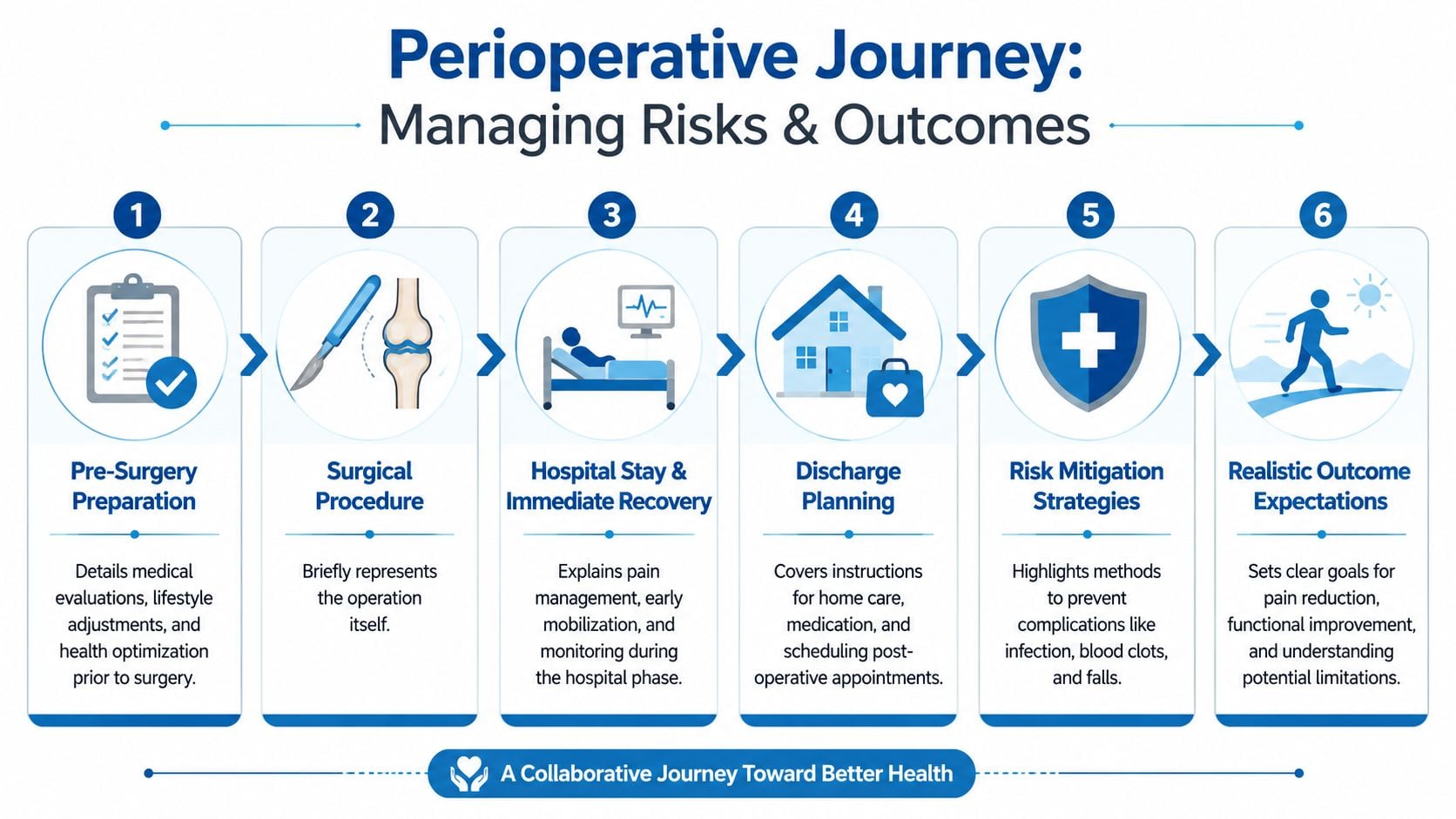
The days around surgery are where careful planning pays off. Preoperative evaluation, anesthesia planning, and wound protection all shape the chance of a smoother recovery. Patients usually do better when they know the sequence ahead of time instead of hearing each step only after it happens.
What the team tries to prevent
The major concerns are infection, blood clots, stiffness, pain that limits early movement, and falls during the early recovery period. None of those risks are handled by one person alone. Surgeons, anesthesia clinicians, nurses, and rehabilitation staff each protect a different part of the process.
Patients can help by showing up prepared. That means sharing medication lists, reporting skin issues or fevers before surgery, and following instructions about fasting, mobility, and wound care. Good preparation is not passive, it's a collaboration.
What recovery commonly feels like
Immediately after surgery, the focus is comfort, monitoring, and safe movement. The knee may be swollen and guarded, and the first goal is usually controlled motion rather than speed. As the patient goes home, instructions become more specific, especially around pain medication, dressing care, and follow-up visits.
Interventional Pain Management is one example of the kind of multidisciplinary setting patients may look for when pain control and rehabilitation need to be coordinated rather than treated as separate problems. That matters most when prior pain has been complex or recovery has been slower than expected.
Questions worth asking before discharge
- How is infection prevention handled? Ask about wound care instructions and warning signs that should trigger a call.
- What limits are there on walking or stairs? Clear activity boundaries reduce guesswork at home.
- Who should be contacted if pain suddenly worsens? Patients do better when the escalation path is obvious.
- Which symptoms are normal, and which are urgent? That distinction lowers anxiety and helps catch real problems earlier.
Rehabilitation Timeline and Alternative Treatments
Rehabilitation works best when the patient understands that recovery has phases, not a single finish line. Early on, the work is about protecting the knee and restoring motion. Later, the work shifts toward strength, balance, and confidence in daily life.
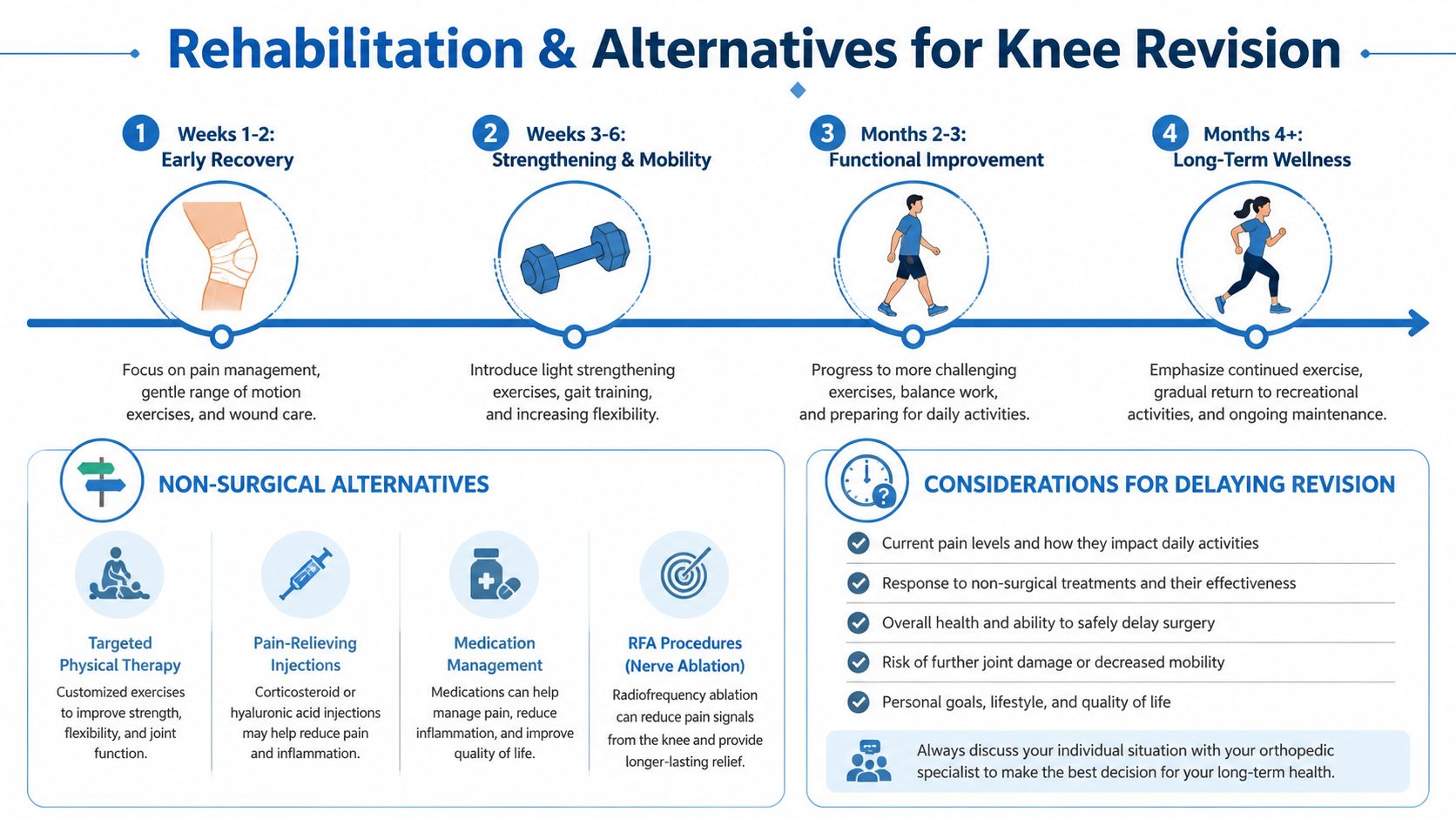
A practical recovery timeline
During the first phase, patients usually focus on pain control, gentle range-of-motion work, and wound care. The next phase adds light strengthening and gait training so walking becomes more natural. Later, balance work and functional drills help the patient handle stairs, transfers, and longer daily routines.
That progression is easier when the therapist adjusts exercises to the knee rather than forcing a generic program. For patients who want a structured rehab reference, expert knee physical therapy can be a useful model for how targeted exercise plans support motion and strength without overloading healing tissue.
Non-surgical ways to manage symptoms
Some patients need time before revision, or they're not sure surgery is the right next step. In that window, conservative care may include targeted physical therapy, pain-relieving injections, medication management, activity modification, or RFA procedures when the pain pattern fits a nerve-targeted approach. Hyaluronic acid injections may also come up in discussions of symptom control for certain knee problems, depending on the clinician's judgment and the patient's anatomy. Hyaluronic acid injection information is one example of how a clinic may organize that discussion.
The main idea is simple. Non-surgical care should not be treated as “doing nothing.” It is a way to reduce symptoms, preserve function, and buy time for a better decision.
What to discuss before delaying surgery
- Pain trajectory: Is the pain stable, improving, or steadily getting worse?
- Function: Is walking, sleeping, or stair climbing becoming harder?
- Safety: Is the knee giving way or causing falls?
- Goals: Is the patient trying to postpone surgery for travel, work, or medical reasons?
How to Choose the Right Surgeon and Center
A good surgeon-patient fit goes beyond technical skill. Revision surgery benefits from a team that can evaluate the knee, explain the plan clearly, and coordinate care across anesthesia, pain management, and rehabilitation. Patients should look for board certification, orthopedic fellowship training, and a center that handles complex joint problems routinely.
What to ask before committing
The first question is whether the surgeon performs revision procedures often enough to be comfortable with complicated findings. The second is whether the center can support the whole process, from imaging review to postoperative rehab coordination. A patient should also ask who helps with insurance checks and whether the office can explain the expected out-of-pocket steps clearly.
Location matters too. If follow-up visits, therapy, or wound checks will be frequent, convenience becomes part of safety. A center with multiple service lines may make it easier to keep the care plan unified rather than scattered across several offices.
How to judge the care model
A useful center usually has more than one specialty involved, because revision cases often benefit from coordinated decision-making. Pain clinicians can help sort persistent symptoms. Orthopedic surgeons handle the implant strategy. Anesthesia and rehabilitation teams shape the recovery plan.
Patients in New Jersey and Staten Island should also ask whether the practice is familiar with the local insurance and out-of-network rules that can affect billing and access. That question is practical, not bureaucratic. It helps avoid surprises when the focus should be on healing.
A well-run center answers the same question from several angles, diagnosis, procedure, pain control, and rehab, so the patient never has to assemble the plan alone.
Conclusion and Key Takeaways
Knee revision decisions become clearer when the patient starts with the cause of pain, not the fear of another operation. RFA procedures may help define or manage pain in selected situations, while revision surgery addresses mechanical problems in the implant itself. The smartest path is the one built from diagnosis, not guesswork.
Patients do best when they know what the workup is looking for, what partial and complete revision mean, and how recovery is organized from the first postoperative day through rehab. They also gain leverage by asking direct questions about surgeon experience, center support, and non-surgical options before agreeing to a plan.
The next step is simple. Bring records, write down the questions that matter most, and use the consultation to confirm whether the plan matches the knee problem that exists.
A CTA for Interventional Pain Management.