
A spinal cord stimulator once made ordinary days possible again. A patient could walk farther, sleep more consistently, or sit through a meal without thinking about pain. Then, gradually, the familiar coverage became faint or patchy. The remote still worked, but the relief no longer matched the promise the device had once delivered. At the next appointment, one question began to surface: should the spinal cord stimulator be removed?
That question can carry grief as well as uncertainty. The implant may represent years of hope, effort, and improved function. Choosing removal isn't a personal failure, and it isn't always an emergency. It's a medical decision that should account for the device's performance, the patient's anatomy, imaging needs, infection status, and the next pain-management plan.
Table of Contents
- When a Spinal Cord Stimulator Stops Working for You
- Understanding the Implanted System and What Removal Means
- Why Spinal Cord Stimulators Are Removed
- What Doctors Check Before Recommending Removal
- How Spinal Cord Stimulator Removal Surgery Is Performed
- Risks and Benefits of Explant Surgery
- Managing Pain After Stimulator Removal and Your Next Steps
When a Spinal Cord Stimulator Stops Working for You
Two years ago, a spinal cord stimulator may have reduced leg pain enough to make grocery shopping manageable. Now, stimulation might cover only part of the painful area. Raising the setting could create uncomfortable sensations elsewhere, while lowering it provides little relief. This change does not mean the patient did anything wrong. Pain can evolve, leads can shift, hardware can malfunction, and the nervous system can respond differently over time.
The first step is to define what “stopped working” means. Relief may have disappeared, narrowed to the wrong body region, or become inconsistent. A patient might still receive some benefit but dislike the generator's position, need an MRI that the system cannot safely accommodate, or develop a problem at the implant site. Each situation calls for a different review, and none automatically requires explantation.
A fading benefit deserves an evaluation, not an automatic trip to the operating room.
A clinician usually works through five practical questions:
- Why has the benefit changed? Possible explanations include reduced efficacy, lead migration, disease progression, malfunction, infection, or a problem unrelated to the implant.
- Can the system be rescued? Reprogramming, imaging, or hardware revision may restore useful coverage in selected cases.
- What exactly needs to come out? Some patients need only the generator removed. Others need both the generator and leads removed.
- What are the surgical trade-offs? The review includes incision healing, scar tissue, anesthesia, lead extraction, and the possibility that pain will return.
- What happens after removal? The plan should address both the original pain and the temporary discomfort associated with surgery.
Removal is a recognized long-term outcome of spinal cord stimulation, and the likelihood can increase with longer follow-up. A multicenter study reported risk reaching 17% at three years, 23% at five years, and 38% at ten years during the study period (multicenter study of SCS and dorsal root ganglion device explantation). These figures describe cumulative experience during that study period, not a prediction for one individual. They also show why explantation is best understood as a decision process that develops over time, rather than as a sudden catastrophe.
Understanding the Implanted System and What Removal Means
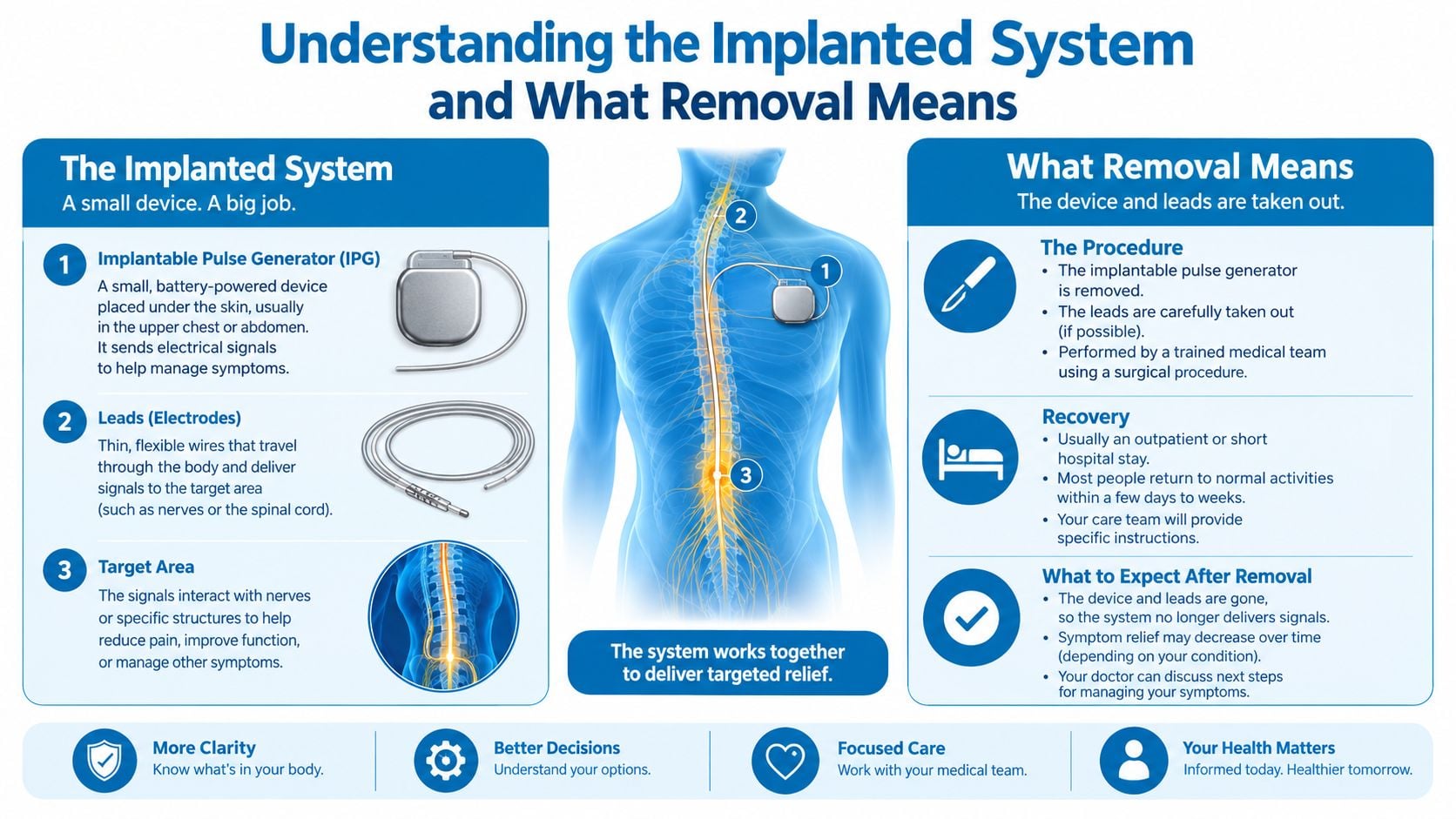
A spinal cord stimulation system works somewhat like a small electrical system for altering pain signals. Leads are thin wires positioned in the epidural space near the spinal cord. They connect to a pulse generator, a battery-powered device placed under the skin, often in the buttock or abdomen. A handheld controller adjusts the stimulation.
The “wiring” analogy helps, but the anatomy matters. The leads aren't just loose wires under the skin. They sit near sensitive structures and may develop scar tissue around them. The generator rests in a surgically created pocket. Over time, the body heals around both parts, which is why removal requires deliberate surgical dissection rather than just pulling the system out.
Patients can learn more about how spinal cord stimulation is used and evaluated through this overview of spinal cord stimulation treatment.
Turning the device off isn't removal
A clinician can turn stimulation off with the controller or programming equipment. The hardware remains inside the body, however. That option may suit a patient who wants to pause treatment, is considering another therapy, or has no current reason to undergo surgery.
Some unused systems remain in place without causing trouble. Other patients prefer removal because the generator is uncomfortable, an infection is present, future imaging is important, or the device has become a reminder of treatment that no longer helps. The choice depends on symptoms, medical need, surgical risk, and personal preference.
Partial and complete explantation
Partial removal often means taking out the pulse generator while leaving leads in place. This may be considered when the generator causes discomfort or when the leads can be left safely. Complete removal involves taking out the generator and the leads, although a surgeon may leave a lead fragment if dense scar tissue makes further dissection more hazardous than beneficial.
Trial failure is different. During a temporary trial, leads are removed at the end of the evaluation period. Permanent spinal cord stimulator removal, also called explantation, involves the implanted generator, permanent leads, or both.
The key distinction is simple: switching a stimulator off changes its function, while explantation changes the anatomy by surgically removing hardware.
Why Spinal Cord Stimulators Are Removed
Removal usually follows a change in the balance between benefit and burden. A stimulator may have reduced pain for years, then gradually become less useful as the underlying condition progresses, the nervous system adapts, coverage no longer reaches the painful area, or programming cannot provide adequate relief.
A retrospective review of 129 patients found that loss of efficacy was associated with 81% of explants, while loss of stimulation coverage was associated with 41.9% (review of spinal cord stimulator hardware explantation). The same review associated 19% of explants with acute postsurgical complications, including infection, hemorrhage, and rare neurologic injury. These findings help separate two decisions: removing hardware because the treatment no longer helps, and removing it because the hardware has caused a direct surgical problem.
MRI access can create another reason to reconsider an implanted system. Some systems have restrictions, while others allow imaging only under specific conditions. If clinically necessary imaging cannot be performed safely with the existing device, the care team may discuss removal or another device strategy.
Infection needs prompt medical assessment, even though it is less common than loss of relief in the cited explantation review. It may involve the generator pocket, the lead pathway, or deeper tissues. Examination, laboratory testing, and imaging when needed help determine how extensive the problem is and what treatment is appropriate.
Leading Causes of Spinal Cord Stimulator Removal
| Reason for removal | Approximate share of explants | Typical timeline |
|---|---|---|
| Diminished pain relief | 55.2% of explants in a multicenter study | More likely as follow-up length increases |
| MRI need | 17.7% of explants in the same study | Can arise whenever clinically necessary imaging becomes unavailable |
| Infection | 8.3% of explants in the same study | Often requires prompt assessment |
| Loss of efficacy | 81% associated with explants in a 129-patient review | May develop gradually or become apparent after a change in pain |
| Loss of stimulation coverage | 41.9% associated with explants in a 129-patient review | Often prompts evaluation for migration or programming problems |
The table combines findings from different studies, so its percentages should not be added together. In the multicenter study cited above, 96 of 400 implanted devices were explanted, representing a cumulative explant risk of 24% during the study period. Diminished relief, MRI need, and infection corresponded to 13%, 4%, and 2% of all implantations, respectively.
Earlier multinational chart data found an overall explant rate of 8.0% per year of follow-up, with a 95% confidence interval of 6.9% to 9.2% (multinational chart review of SCS implants). Differences among studies may reflect patient selection, device type, clinical indications, and follow-up duration.
For a long-term SCS patient, removal is therefore a decision process rather than a single event. The team weighs whether the therapy still offers meaningful relief, whether imaging or infection changes the medical need, and what pain plan will replace stimulation after the hardware is gone.
What Doctors Check Before Recommending Removal
A physician usually treats “the stimulator isn't helping” as a diagnostic statement, not a final diagnosis. The evaluation starts with the patient's pain map. If the painful area has changed, a clinician compares the current pattern with the original target and asks whether the device still covers any meaningful portion of the symptoms.
The diagnostic sequence
Programming comes first when appropriate. A neuromodulation team can review previous settings and test alternative programs. The objective isn't merely to increase intensity. It's to determine whether stimulation can reach the relevant pain without creating uncomfortable or distracting sensations.
Imaging checks lead position. Plain radiographs or other appropriate imaging may show whether a lead has moved from its intended location. A new gap in coverage, especially after a fall or procedure, can make migration more likely, although only a clinician can interpret the finding in context.
Hardware testing looks for malfunction. The team may assess the generator, connections, battery, and leads. A device can appear active while still failing to deliver useful therapy because of a connection problem, fracture, depleted battery, or other technical issue.
Infection screening can't be skipped. Redness, warmth, drainage, swelling, worsening tenderness, fever, or systemic illness should be reported promptly. A quiet-appearing incision doesn't rule out every problem, so the clinician may use examination, laboratory testing, or imaging based on the findings.
The review of explanted hardware supports checking lead migration, coverage loss, infection, and malfunction before proceeding when the clinical situation allows. Not every failing system can be restored, but some can be improved without complete removal.
A useful appointment question is, “What evidence shows that removal is safer or more helpful than reprogramming, revision, or observation?”
When removal becomes the clearer path
Explantation may become reasonable when infection can't be controlled while hardware remains, relief has completely and persistently disappeared, MRI access is medically necessary, the device causes unacceptable discomfort, or the patient no longer wants the system. The final decision should account for the lead type, scar tissue, prior spine operations, overall health, and the patient's goals.
A multidisciplinary practice may coordinate pain medicine, spine surgery, imaging, physical therapy, and medication review. Injections may also be considered for selected pain patterns, including epidural steroid injection care, but an injection isn't a substitute for urgent assessment of suspected implant infection.
How Spinal Cord Stimulator Removal Surgery Is Performed
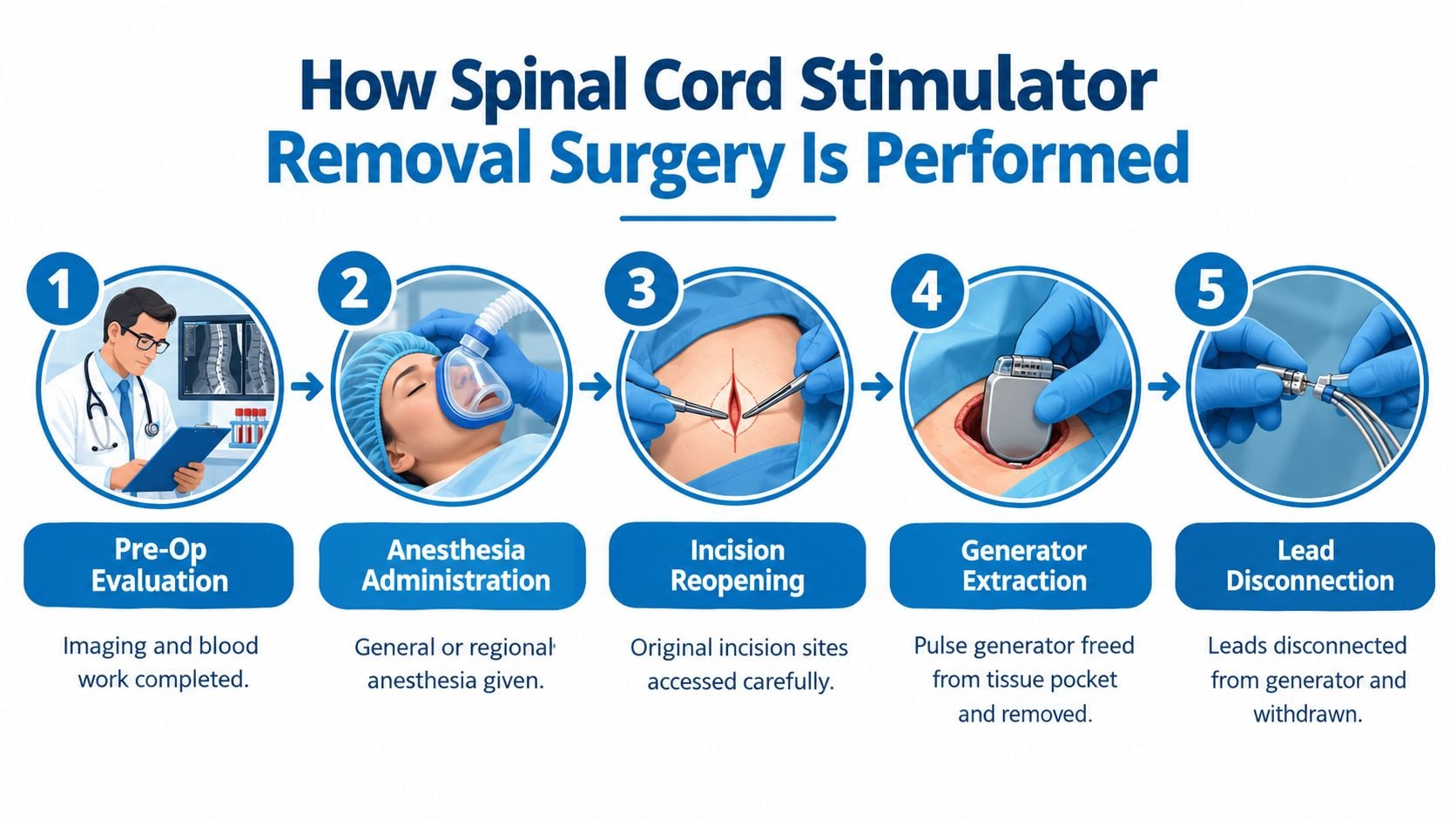
The operation begins with a review of the implant records, the current symptoms, imaging, medications, and anesthesia needs. The surgeon identifies where the generator and leads are located and considers whether the system was placed through a minimally invasive route or with a more extensive approach. The exact plan varies with lead design, prior surgery, scar tissue, and the reason for removal.
Arrival and anesthesia
After check-in, the surgical team confirms the procedure, implant locations, allergies, medications, and postoperative transport arrangements. Anesthesia may be general or regional, depending on the operation and the patient's health. The team explains the selected method before surgery rather than treating anesthesia as an afterthought.
Reopening the original access sites
The surgeon generally uses the previous incision areas when practical. The generator is located within its skin pocket and freed from the surrounding tissue. The connecting cable is then followed toward the leads.
Lead removal resembles taking down an old tent line that has become anchored in the ground. Pulling forcefully could damage the surrounding tissue, so the surgeon works gradually, releasing scar tissue and applying controlled traction. The goal is complete removal when it can be performed safely, but anatomy can make a small retained fragment the safer choice.
Closure and discharge
Once the intended hardware is removed, the surgical sites are inspected, irrigated when appropriate, and closed. Dressings protect the incisions during the early healing period. Many procedures are arranged as same-day or short-stay surgery, although the expected setting depends on the patient's health and the complexity of extraction.
Patients commonly wake with soreness at the generator pocket and lead-access sites. The surgical team provides instructions for wound care, bathing, medication use, and activity limits. Heavy lifting, strenuous bending, and other movements may be restricted while the incisions heal. The surgeon's instructions take priority because restrictions depend on the operation performed.
The early recovery plan usually includes watching for increasing redness, drainage, opening of the incision, fever, worsening pain, new weakness, or other concerning changes. A follow-up visit allows the team to assess healing and adjust the longer-term pain plan.
Risks and Benefits of Explant Surgery
Removal can solve a real problem, but it doesn't erase the risks of another operation. The decision is strongest when the expected benefit matches the patient's main concern.
Potential benefits
Removing the generator may eliminate pressure, tenderness, or discomfort at the pocket. Removing infected hardware can form part of an infection-control plan. If the system prevents needed imaging, explantation may restore access to examinations that clinicians consider important.
Some patients also want to end future battery maintenance or avoid additional procedures related to a device that no longer provides meaningful relief. Psychological closure can matter, especially when the implant has become associated with repeated disappointments.
Potential risks
Surgical-site infection, bleeding, anesthesia complications, and delayed wound healing are possible. Lead extraction can irritate nearby tissues, and scar tissue may make the procedure more technically demanding. Dural injury, cerebrospinal fluid leakage, neurologic injury, or retained lead material are less common but important subjects for the consent discussion.
A retained fragment isn't automatically a failed operation. If the lead is firmly incorporated into scar tissue, a surgeon may decide that aggressive extraction creates more danger than benefit. The operative plan should explain when complete removal is intended and when a fragment might reasonably remain.
The central trade-off
The most important outcome question is whether pain will return after stimulation stops. Some patients experience a return toward their prior pain level. Others retain some improvement, develop a different pain pattern, or find that another diagnosis explains the remaining symptoms. No clinician can promise a specific pain trajectory from removal alone.
| Potential benefit | Potential concern |
|---|---|
| Less generator discomfort | Incision soreness and scarring |
| Removal of an infection source when clinically indicated | Surgical-site infection |
| Improved access to medically necessary imaging | Anesthesia and bleeding risks |
| No further device maintenance | Return of chronic pain |
| Closure after ineffective treatment | Lead extraction may be limited by scar tissue |
Patients should bring their own priorities into the discussion. For one person, MRI access may dominate. For another, the decisive issue may be a painful generator pocket or complete loss of relief. A shared decision balances those goals against the anatomy and surgical findings.
Managing Pain After Stimulator Removal and Your Next Steps
Pain after removal has two layers. The first is short-term surgical soreness around the incisions. The second is the underlying pain condition that the stimulator had been treating. A discharge plan should address both rather than assuming that removing the hardware completes treatment.
The original pain may return toward its pre-implant level, remain partly improved, or change in character. The outcome depends on the original diagnosis, current nerve or spine findings, duration of benefit, other treatments, and the reason the device was removed. A clinician may use a staged plan that begins with wound care and short-term medication review, then moves toward rehabilitation and longer-term treatment.
Rebuilding the treatment plan
Possible components include:
- Medication review: Adjusting existing medicines for safety, function, side effects, and interactions.
- Targeted injections: Epidural steroid injections, nerve blocks, or trigger point injections when examination and imaging support them.
- Physical therapy: Restoring movement, strength, conditioning, and confidence after the surgical recovery period.
- Diagnostic reassessment: Reviewing updated imaging and looking for structural, nerve-related, joint, or myofascial contributors.
- Alternative neuromodulation or revision: Considering another device strategy only when the clinical rationale is clear and the patient understands the trade-offs.
Patients with persistent symptoms after back surgery may also benefit from a broader assessment of pain after back surgery, because ongoing pain can arise from several overlapping sources rather than one failed device.
Follow-up matters after any future implant or revision decision. The available evidence shows that removals can occur early as well as later, so programming review, lead-position assessment when symptoms change, and infection surveillance should remain part of care. Early attention may identify a solvable problem before it becomes a decision about complete explantation.

For adults in New Jersey and Staten Island, a multidisciplinary pain and spine consultation can evaluate surgical and non-surgical paths, including interventional procedures, rehabilitation, medication strategy, and spine assessment. Interventional Pain Management provides these services through board-certified physicians and offers scheduling availability seven days a week.
Interventional Pain Management can review a failing or uncomfortable spinal cord stimulator, assess whether programming or revision remains reasonable, and plan removal when explantation is appropriate. Patients in New Jersey and Staten Island can visit Interventional Pain Management to request a consultation covering both the device and the next step for ongoing pain.